3.4 - Refrigerant Identification
Technical source review date: August 7, 2026
Primary technical basis: Current project Module 3 outline, EPA 608 study material, HVAC licensing references, and refrigerant pressure-temperature data in NCEES PE Mechanical reference data
Course role: Develops a technician-level process for confirming refrigerant identity before charging, recovery, service, or transfer and for preventing cross-contamination when the refrigerant is uncertain
Learning Objectives
After completing this section, a student should be able to:
- Identify the equipment nameplate and refrigerant-cylinder label as primary refrigerant-identification sources.
- Explain why cylinder color alone is not a reliable method of refrigerant identification.
- Use pressure-temperature behavior as a consistency check while recognizing its limitations.
- Explain when a refrigerant analyzer is appropriate and what problem it helps prevent.
- Describe the consequences of mixed-refrigerant contamination.
- Select service and recovery practices that minimize cross-contamination, including dedicated or properly cleaned equipment.
Introduction
Correct refrigerant identification must occur before refrigerant is added to a system, recovered into a cylinder, transferred, or mixed with an existing refrigerant charge.
Using the wrong refrigerant can create:
- Incorrect operating pressures.
- Incorrect pressure-temperature relationships.
- Loss of system performance.
- Lubricant or material-compatibility problems.
- Safety concerns.
- Contamination of recovery equipment and recovery cylinders.
- Refrigerant that cannot be readily reused or reclaimed as originally intended.
For EPA Section 608 preparation, the central rule is simple:
Do not identify refrigerant from one clue alone when the identity is uncertain.
A reliable technician begins with the strongest documented sources:
- Equipment nameplate or permanent equipment labeling.
- Refrigerant-cylinder label.
- Refrigerant service records when available.
- Pressure-temperature comparison under suitable conditions.
- Refrigerant analyzer when identity or purity remains uncertain.
Cylinder color can be a visual clue, but it is not sufficient identification by itself.
Key Concepts
1. Refrigerant Identity Must Be Established Before Service
Before connecting charging or recovery equipment, the technician should know what refrigerant is expected in the system.
This is important because refrigerants differ in:
- Saturation pressure.
- Saturation temperature.
- Blend composition.
- Temperature glide.
- Lubricant compatibility.
- Equipment design pressure.
- Safety classification.
- Recovery-equipment compatibility.
A refrigerant that appears to operate at a familiar pressure may still be:
- A different refrigerant.
- A blend.
- Contaminated.
- Mixed with another refrigerant.
- Mixed with noncondensable gas.
Therefore, pressure alone is not proof of refrigerant identity.
2. Use Documented Identification Before Appearance
The strongest routine identification information usually comes from written equipment and container markings.
For equipment:
Equipment nameplate / permanent refrigerant label
→ intended refrigerant
For a refrigerant container:
Cylinder label
→ refrigerant actually packaged in that cylinder
These sources are more reliable than cylinder paint color or assumptions based on system pressure.
3. Verify Rather Than Guess
If the equipment label, cylinder label, service history, and measured behavior do not agree:
Stop and verify before charging or recovery.
Do not:
- Add refrigerant simply because the pressure “looks about right.”
- Mix an unknown refrigerant into a clean recovery cylinder.
- Guess from cylinder color.
- Assume a replacement refrigerant is the original refrigerant.
- Add individual blend components to correct an unknown mixture.
A refrigerant analyzer can be used when additional identification is needed.
Equipment Nameplate
1. Why the Nameplate Matters
The equipment nameplate or permanent manufacturer label normally identifies the refrigerant for which the equipment was designed.
Depending on the equipment, the nameplate may also show information such as:
- Refrigerant designation.
- Factory charge.
- Electrical ratings.
- Model number.
- Serial number.
- Design or test pressures.
- Certification markings.
For refrigerant identification, the most important item is the refrigerant designation.
Examples of designations include:
R-22
R-134a
R-410A
R-407C
R-454B
The complete designation matters.
For example:
R-407C
must not be shortened casually to:
R-407
because suffixes can identify different formulations.
2. The Nameplate Identifies the Intended Refrigerant
A key limitation is:
The nameplate identifies what refrigerant the equipment is intended to contain. It does not guarantee that the refrigerant currently inside the equipment is still that refrigerant.
A system may have been:
- Retrofitted.
- Improperly charged.
- Contaminated.
- Serviced with the wrong refrigerant.
- Relabeled incorrectly or incompletely.
Therefore, the nameplate is the first identification source, not an absolute purity test.
3. Retrofit Labels
When equipment has been properly converted to an approved substitute refrigerant, the original nameplate may no longer describe the current charge by itself.
A technician should look for:
- Retrofit labels.
- Service labels.
- Updated refrigerant identification.
- Lubricant information.
- Service records.
Detailed retrofit procedures are developed in Section 3.7 - Retrofitting and Substitute Refrigerants.
4. Damaged or Missing Nameplates
If a nameplate is missing, unreadable, or inconsistent with other evidence:
- Do not guess.
- Check manufacturer information using the model and serial number when possible.
- Review service records.
- Compare pressure-temperature behavior when appropriate.
- Use a refrigerant analyzer if the refrigerant remains uncertain.
Refrigerant-Cylinder Label
1. Read the Label Before Connecting the Cylinder
A refrigerant cylinder should be identified by its label and markings, not merely by appearance.
Before connecting a cylinder, verify:
- Refrigerant designation.
- Whether the cylinder contains new, recovered, recycled, or reclaimed refrigerant as applicable.
- Cylinder type.
- Any relevant safety information.
- Whether the label is legible and consistent with the intended service.
The most important first question is:
Does the cylinder label identify the same refrigerant required by the equipment?
2. Do Not Assume the Cylinder Contents Match an Old Marking
A recovery cylinder can be reused.
Therefore, the technician should also consider whether:
- The current label is clear.
- The cylinder has been properly prepared for the refrigerant.
- Previous refrigerant has been removed as required.
- The cylinder is known to contain only the intended refrigerant.
A clean label on a contaminated cylinder does not make the refrigerant pure.
3. Disposable Supply Cylinder Versus Recovery Cylinder
A new refrigerant supply cylinder and a reusable recovery cylinder have different service roles.
For identification:
- A sealed supply cylinder should be identified from the manufacturer’s label.
- A recovery cylinder must be clearly labeled for the refrigerant actually recovered into it.
Detailed recovery-cylinder construction and handling rules are covered later in Module 5.
Why Cylinder Color Is Not Sufficient
1. Color Is Only a Visual Clue
Older HVAC training commonly associated particular refrigerants with particular cylinder colors.
Color can be memorable, but it is not a reliable stand-alone identification method.
A cylinder can be:
- Repainted.
- Faded.
- Dirty.
- Corroded.
- Incorrectly marked.
- Reused.
- Produced under a different color convention.
Therefore:
Read the refrigerant label. Do not identify refrigerant from cylinder color alone.
2. Color Cannot Confirm Purity
Even if a cylinder’s paint color appears consistent with an expected refrigerant, color cannot tell the technician whether the contents are:
- Pure.
- Mixed.
- Contaminated.
- Correctly transferred.
- Previously recovered.
Only the actual refrigerant and reliable identification information can establish that.
3. Exam Interpretation
If a practice question asks for the best method of identifying refrigerant in a labeled supply cylinder, the label is a stronger answer than color.
If a question involves an unknown recovered refrigerant, neither label history nor color may be sufficient; additional verification such as pressure-temperature comparison or analysis may be needed.
Pressure-Temperature Relationship
1. Refrigerants Have Characteristic Saturation Relationships
Each refrigerant has a characteristic relationship between:
- Saturation pressure.
- Saturation temperature.
For a known pure refrigerant at equilibrium:
Known temperature
↔ expected saturation pressure
or:
Known pressure
↔ expected saturation temperature
This relationship can help determine whether the refrigerant behaves consistently with the expected refrigerant.
2. Pressure-Temperature Comparison Is a Consistency Check
A P-T comparison can answer a question such as:
“Does the observed pressure-temperature behavior appear consistent with the refrigerant that the label says should be present?”
It should not automatically be interpreted as:
“This pressure proves exactly which refrigerant is present and proves that it is pure.”
3. Suitable Conditions Matter
For a meaningful static pressure-temperature comparison:
- The refrigerant should have had time to approach thermal equilibrium.
- The refrigerant temperature should be measured or reasonably established.
- The pressure should correspond to the refrigerant sample being evaluated.
- The correct refrigerant P-T data must be used.
- Gauge versus absolute pressure must not be confused.
If a system has just operated, pressures can reflect:
- Compression.
- Flow.
- Heat-transfer conditions.
- Pressure drop.
- Superheat.
- Subcooling.
Operating pressure is therefore not the same as a simple static saturation-pressure test.
4. Pure Refrigerants
For a pure refrigerant in a closed container containing both liquid and vapor at equilibrium:
- Pressure and saturation temperature should correspond closely to the refrigerant’s published P-T relationship.
A large mismatch suggests that the technician should investigate.
Possible causes include:
- Wrong refrigerant.
- Mixed refrigerants.
- Noncondensables.
- Incorrect temperature measurement.
- Incorrect pressure measurement.
- Lack of equilibrium.
5. Zeotropic Blends
Sections 3.2 and 3.3 established that a zeotropic blend can have:
- Bubble-point temperature.
- Dew-point temperature.
- Temperature glide.
Therefore, a technician must use the correct published blend data.
Do not apply a pure-refrigerant one-temperature assumption automatically to a zeotropic blend.
For more detail, see:
- Section 3.2 - Pure Refrigerants and Refrigerant Blends
- Section 3.3 - Temperature Glide Bubble Point and Dew Point
6. Why Pressure Alone Is Not Enough
Suppose a technician measures only pressure.
That pressure does not uniquely identify refrigerant because:
- Different refrigerants can have similar pressures under some conditions.
- Pressure changes with temperature.
- Blends require correct bubble/dew interpretation.
- Mixed refrigerants can produce unexpected behavior.
- Noncondensables can alter pressure.
- An operating system does not necessarily represent saturation equilibrium.
Therefore:
Pressure must be interpreted with temperature, refrigerant data, and system condition.
Refrigerant Analyzers
1. Purpose
A refrigerant analyzer is an instrument used to help identify refrigerant and evaluate whether the sample appears to match an expected refrigerant or refrigerant composition.
Analyzers are especially useful when:
- The refrigerant is unknown.
- Labels are missing or unreliable.
- Service history is uncertain.
- Pressure-temperature behavior does not match expectations.
- Mixed refrigerants are suspected.
- A recovery cylinder may contain contaminated refrigerant.
2. Analyzer Use Is Stronger Than Guessing
When refrigerant identity is uncertain, analysis can provide more direct information than:
- Cylinder color.
- Pressure alone.
- Technician memory.
- Odor.
- Assumption based on equipment age.
Refrigerant should never be intentionally inhaled or identified by smell.
3. Analyzer Limitations
An analyzer is not a substitute for correct service judgment.
The technician must:
- Follow the analyzer manufacturer’s instructions.
- Use the correct sampling procedure.
- Keep sampling connections clean.
- Understand what refrigerants the analyzer can identify.
- Interpret purity or composition results according to the instrument’s capabilities.
- Avoid contaminating the analyzer with oil, liquid refrigerant, or debris when prohibited by its instructions.
Not every analyzer identifies every refrigerant or every contaminant.
4. Analyzer Result and Equipment Label Should Be Reconciled
If the analyzer result disagrees with the equipment label:
Do not charge
Do not mix into a clean recovery cylinder
Do not assume the analyzer or label can simply be ignored
Instead:
- Recheck the sampling procedure.
- Verify equipment history.
- Confirm the refrigerant with appropriate technical information.
- Isolate the suspect refrigerant from clean stock.
Mixed-Refrigerant Contamination
1. What Mixed-Refrigerant Contamination Means
Mixed-refrigerant contamination occurs when two or more refrigerants that are not intended to form that specified refrigerant are combined.
Examples include:
- Recovering R-22 into a cylinder already containing R-410A.
- Adding an incorrect refrigerant to an existing system.
- Connecting contaminated hoses or equipment without proper preparation.
- Combining unknown recovered refrigerant with known clean refrigerant.
This is different from a manufactured refrigerant blend such as R-407C.
R-407C is a specified refrigerant formulation.
An accidental mixture of unrelated refrigerants is contamination.
2. Consequences of Mixing Refrigerants
Mixed refrigerants can cause:
- Unpredictable pressure-temperature behavior.
- Incorrect superheat or subcooling interpretation.
- Reduced capacity.
- Abnormal operating pressures.
- Lubricant-compatibility problems.
- Difficulty identifying the refrigerant.
- Contamination of recovery machines, hoses, manifolds, and cylinders.
- Loss of the ability to reuse refrigerant as originally intended.
- Increased reclamation or disposal difficulty.
3. Mixed Refrigerant Is Not “Another Blend”
A common misconception is:
“If two refrigerants are mixed, the result is just another blend.”
That is not a safe service assumption.
Commercial refrigerant blends have:
- Defined components.
- Defined proportions.
- Published properties.
- Assigned refrigerant designations.
- Known safety classifications.
An accidental mixture does not automatically have those properties.
4. Do Not Top Off With a Different Refrigerant
Do not add another refrigerant merely because:
- Its pressure is similar.
- It is marketed as a replacement.
- The original refrigerant is expensive.
- The original refrigerant is unavailable.
- The cylinder connection fits.
Substitute refrigerants and retrofit decisions are developed in Section 3.7.
Preventing Cross-Contamination
1. Dedicated Equipment
Where practical or required by the equipment/refrigerant manufacturer, use dedicated service or recovery equipment for a refrigerant or refrigerant family.
Dedicated equipment reduces the chance that residual refrigerant from previous service contaminates the next system or recovery cylinder.
Items that can retain refrigerant include:
- Recovery machines.
- Hoses.
- Manifold sets.
- Recovery cylinders.
- Oil inside recovery equipment.
- Filters and separators.
2. Properly Cleaned or Purged Equipment
When equipment is approved for use with multiple refrigerants, follow the equipment manufacturer’s procedure for changing refrigerants.
Depending on the equipment, the procedure may involve:
- Recovering residual refrigerant.
- Purging or evacuating internal passages.
- Changing or servicing filters.
- Managing recovery-machine oil.
- Using clean hoses.
- Using an appropriate clean recovery cylinder.
Do not invent a universal cleaning procedure.
The equipment manufacturer’s instructions control the changeover procedure.
3. Recovery Cylinder Discipline
Before recovery:
- Identify the refrigerant.
- Select the correct recovery cylinder.
- Confirm what is already in that cylinder.
- Do not combine different known refrigerants.
- Clearly label recovered refrigerant.
If refrigerant is unknown or suspected to be mixed:
- Keep it separate from known refrigerant.
- Use an appropriately identified recovery container.
- Follow company, reclaimer, and equipment procedures for contaminated refrigerant.
4. Hose and Manifold Residual Refrigerant
A small quantity of refrigerant can remain in:
- Charging hoses.
- Manifold passages.
- Recovery connections.
That residual amount can contaminate another refrigerant, especially in small systems or repeated service work.
Good practice is to:
- Minimize retained refrigerant.
- Follow equipment purge procedures.
- Use dedicated sets where practical for refrigerants that require separation.
- Keep service connections clean and capped.
Refrigerant Identification Workflow
A practical technician sequence is:
1. Read equipment nameplate / permanent label
↓
2. Read refrigerant-cylinder label
↓
3. Compare with service or retrofit records
↓
4. If needed, check pressure-temperature consistency
↓
5. If still uncertain, analyze the refrigerant
↓
6. If identity or purity is uncertain, isolate it
↓
7. Use dedicated or properly prepared equipment
↓
8. Prevent mixing during charging and recovery
Decision Principle
If all reliable sources agree:
Proceed using the verified refrigerant and correct service procedure.
If reliable sources disagree:
Stop → investigate → identify before mixing or charging.
Technical Details
1. Expected Refrigerant Versus Actual Refrigerant
Keep these separate:
| Question | Best Initial Source |
|---|---|
| What refrigerant was the equipment designed for? | Equipment nameplate / manufacturer information |
| What refrigerant is in a new supply cylinder? | Cylinder manufacturer’s label |
| Does the sample behave consistently with that refrigerant? | P-T comparison under suitable conditions |
| Is an unknown sample actually the expected refrigerant? | Refrigerant analyzer plus supporting information |
| Is recovered refrigerant known to be clean and unmixed? | Service history, labeling, segregation, and analysis when needed |
2. P-T Comparison Cannot Establish Purity by Itself
Even if pressure and temperature appear close to a published saturation value, a P-T check does not prove laboratory-grade purity.
A contaminated mixture may:
- Coincidentally resemble the expected pressure at one temperature.
- Deviate more strongly at another temperature.
- Contain contaminants not obvious from one static reading.
A P-T comparison is therefore best treated as a screening and consistency check.
3. Static Equilibrium Is Different From Operating Condition
A system running under load has different pressures throughout the circuit.
A stationary cylinder or isolated refrigerant sample containing liquid and vapor can approach equilibrium and is more suitable for a basic saturation comparison.
Therefore, do not compare:
compressor discharge pressure
directly with:
simple saturation pressure at ambient temperature
and conclude that the refrigerant is wrong.
4. Noncondensables Can Distort Identification
Air or another noncondensable gas in a refrigerant sample can increase total measured pressure.
Therefore:
unexpectedly high pressure at a known temperature
does not automatically mean:
the refrigerant must be a higher-pressure refrigerant
It can also indicate contamination.
Noncondensables are developed further in Section 3.6 - Moisture Acid and Noncondensables.
5. Identification Must Precede Mixing
The safest place to solve an identification problem is before refrigerant enters:
- The appliance.
- A clean recovery cylinder.
- A recovery machine containing another refrigerant.
- A reclaim batch.
- A charging cylinder.
Once refrigerants are mixed, separation and reuse become more difficult.
Important Terms
Cross-Contamination
Cross-contamination is the unintended transfer of one refrigerant, oil, or contaminant into equipment or refrigerant intended to remain separate.
Cylinder Label
A cylinder label identifies the refrigerant or material assigned to the cylinder and provides information needed for safe handling. It is a primary identification source and is more reliable than color alone.
Dedicated Equipment
Dedicated equipment is service or recovery equipment reserved for a specific refrigerant or defined application to reduce contamination risk.
Equipment Nameplate
An equipment nameplate is the manufacturer’s permanent identification plate or label that provides equipment data, including the intended refrigerant when applicable.
Mixed Refrigerant
A mixed refrigerant in this context is an unintended combination of refrigerants rather than a properly manufactured refrigerant blend with a defined designation and composition.
Pressure-Temperature Relationship
The pressure-temperature relationship is the refrigerant-specific relationship between saturation pressure and saturation temperature.
Refrigerant Analyzer
A refrigerant analyzer is an instrument used to help identify a refrigerant sample and, depending on the instrument, evaluate its composition or purity.
Refrigerant Identification
Refrigerant identification is the process of determining what refrigerant is intended, supplied, or actually present before service or recovery decisions are made.
Retrofit Label
A retrofit label records that equipment has been converted from its original refrigerant to another approved refrigerant and identifies relevant service information.
Figures and Diagrams
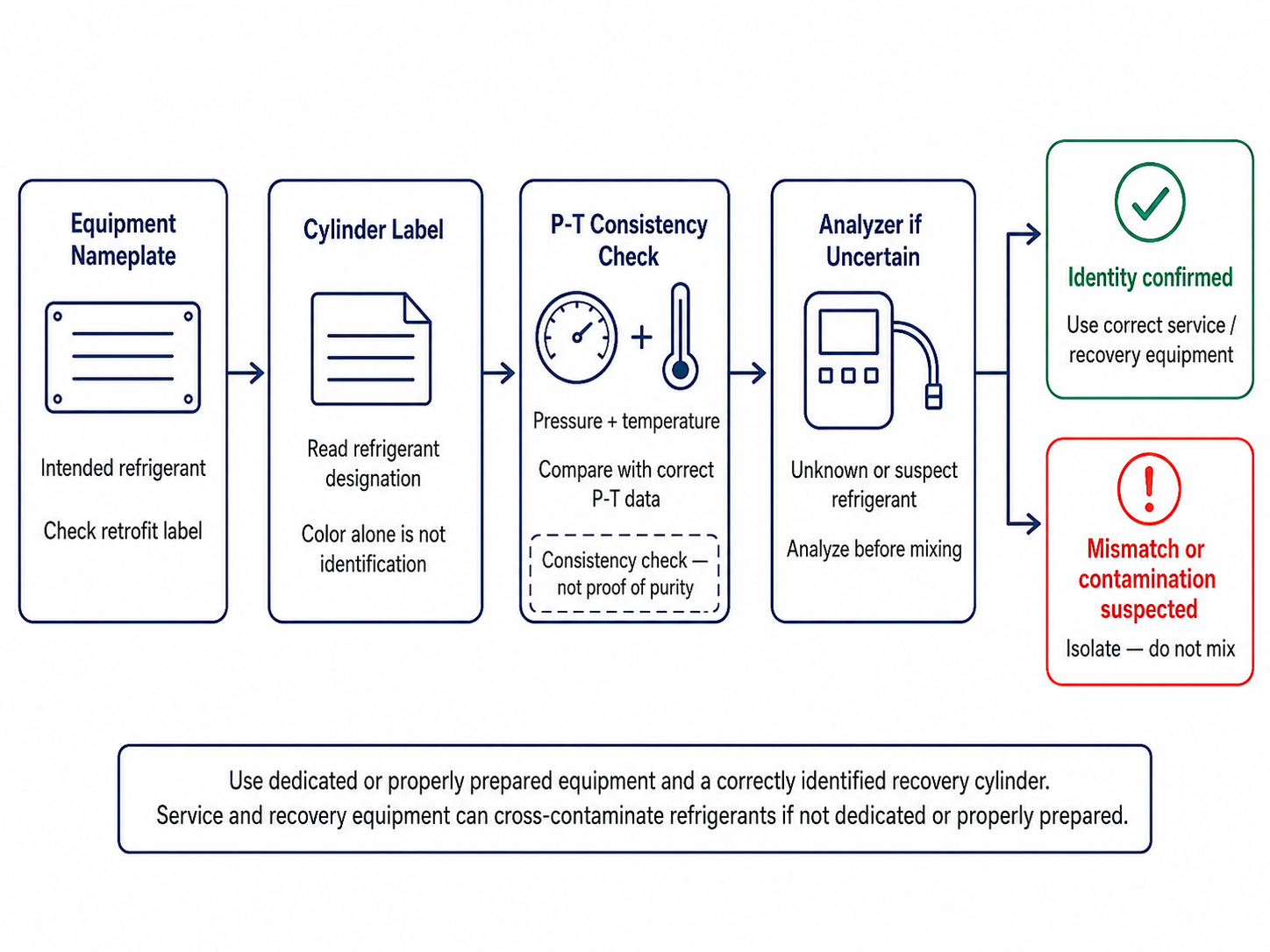
Figure 3.4.1 – Refrigerant identification sources and verification sequence before charging or recovery.
AI-generated instructional figure: It may contain visual inaccuracies. Use the accompanying lesson text and cited authoritative sources to verify technical and regulatory details.
EPA 608 Exam Focus
What Students Must Remember
- Identify refrigerant before charging or recovery.
- Equipment nameplate identifies the refrigerant the equipment was designed to use.
- A retrofit or service label can modify the identification history.
- Read the cylinder label before connecting refrigerant.
- Cylinder color alone is not sufficient identification.
- Refrigerants have different pressure-temperature relationships.
- Pressure by itself does not identify an unknown refrigerant.
- A meaningful P-T check requires the correct temperature, refrigerant data, and suitable system condition.
- P-T comparison is a consistency check, not proof of purity.
- Zeotropic blends require correct bubble/dew interpretation.
- Use a refrigerant analyzer when identity or purity remains uncertain.
- Do not mix unknown refrigerant with known refrigerant.
- Accidental mixtures are not equivalent to properly manufactured refrigerant blends.
- Dedicated or properly prepared recovery/service equipment helps prevent cross-contamination.
- Follow equipment-manufacturer procedures when changing the refrigerant handled by recovery equipment.
Typical Exam Question Patterns
Students may be asked to:
- Select the equipment nameplate as the source for the intended refrigerant.
- Select the cylinder label over cylinder color for refrigerant identification.
- Explain why color alone is unreliable.
- Identify pressure plus temperature as necessary for a P-T comparison.
- Explain why one operating pressure does not prove refrigerant identity.
- Choose an analyzer when refrigerant identity is uncertain.
- Recognize the danger of mixing refrigerants in a recovery cylinder.
- Distinguish a manufactured blend from accidental mixed-refrigerant contamination.
- Select dedicated or properly cleaned equipment as a contamination-control measure.
High-Priority Identification Table
| Situation | Best Technician Action |
|---|---|
| Need intended equipment refrigerant | Read nameplate / retrofit label |
| Need supply-cylinder refrigerant | Read cylinder label |
| Cylinder color looks familiar | Verify label; do not rely on color |
| Static P-T behavior matches expected refrigerant | Treat as supporting evidence, not proof of purity |
| P-T behavior does not match | Stop and investigate |
| Refrigerant identity unknown | Analyze before mixing |
| Recovery cylinder contains another refrigerant | Do not add a different refrigerant |
| Recovery equipment changed to another refrigerant | Follow manufacturer purge/cleaning procedure or use dedicated equipment |
| Suspected mixed refrigerant | Isolate and label appropriately |
Common Mistakes and Confusing Points
Mistake 1: Identifying Refrigerant by Cylinder Color
Color is not sufficient.
Read the refrigerant label.
Mistake 2: Assuming the Nameplate Proves What Is Currently in the System
The nameplate identifies the intended refrigerant.
A retrofit, improper service, or contamination can change the actual contents.
Mistake 3: Using Pressure Alone to Identify Refrigerant
Pressure must be interpreted with temperature and system condition.
Mistake 4: Using Running Pressure as a Static Saturation Test
Operating pressure reflects the refrigeration process and is not the same as equilibrium pressure in a stationary sample.
Mistake 5: Assuming a Matching P-T Point Proves Purity
P-T behavior can support identification but does not prove purity by itself.
Mistake 6: Ignoring Bubble and Dew Data for a Zeotropic Blend
A zeotropic blend may require different liquid and vapor saturation references.
Mistake 7: Treating an Accidental Mixture as a New Refrigerant Blend
A manufactured blend has defined composition and published properties.
An accidental mixture does not.
Mistake 8: Recovering Unknown Refrigerant Into a Cylinder of Known Refrigerant
This contaminates the known refrigerant.
Keep unknown material separate.
Mistake 9: Assuming the Recovery Machine Cannot Contaminate Refrigerant
Residual refrigerant can remain in recovery equipment, hoses, oil, or filters.
Use dedicated equipment or the manufacturer’s proper changeover procedure.
Mistake 10: Using Smell to Identify Refrigerant
Do not intentionally inhale refrigerant for identification.
Use labels, technical data, and appropriate instruments.
Concept-Check Questions
Question 1
Which source most directly identifies the refrigerant an appliance was designed to use?
A. Cylinder paint color
B. Equipment nameplate or permanent refrigerant label
C. Compressor sound
D. Outdoor air temperature
Question 2
Why should refrigerant not be identified from cylinder color alone?
A. Refrigerant cylinders are never painted.
B. Every refrigerant uses the same required color.
C. Color can be unreliable and does not prove the actual refrigerant or purity.
D. Cylinder color identifies only the refrigerant’s pressure.
Question 3
Which information is required for a meaningful refrigerant pressure-temperature comparison?
A. Pressure only
B. Temperature only
C. Cylinder color and equipment age
D. Pressure, temperature, correct refrigerant data, and suitable system condition
Question 4
A system’s static pressure-temperature behavior does not agree with the refrigerant shown on the equipment label. What is the best next action?
A. Add more of the labeled refrigerant immediately.
B. Stop and investigate the refrigerant identity before mixing or charging.
C. Vent enough refrigerant until the pressure matches the chart.
D. Identify the refrigerant from cylinder color.
Question 5
When is a refrigerant analyzer especially useful?
A. When the refrigerant identity is unknown or contamination is suspected
B. Whenever a cylinder label is clear and trustworthy
C. Only for measuring compressor amperage
D. Only for determining refrigerant-cylinder weight
Question 6
Which statement correctly distinguishes a manufactured refrigerant blend from accidental mixed-refrigerant contamination?
A. They are always equivalent if they contain two refrigerants.
B. An accidental mixture automatically receives a 400-series designation.
C. A manufactured blend has a defined formulation and published properties; an accidental mixture does not automatically have those characteristics.
D. Accidental mixtures always have zero temperature glide.
Question 7
A recovery cylinder already contains known R-22. What should a technician do with an unknown refrigerant recovered from another system?
A. Add it to the R-22 cylinder if the pressures are similar.
B. Add it to the cylinder if both refrigerants are vapor.
C. Keep the unknown refrigerant separate and identify or handle it as suspect material.
D. Mix the two refrigerants and relabel the cylinder as a blend.
Question 8
Why may dedicated or properly prepared recovery equipment be needed when changing refrigerants?
A. To prevent residual refrigerant in the equipment from cross-contaminating the next refrigerant
B. To make every refrigerant have the same pressure-temperature relationship
C. To convert an unknown refrigerant into a pure refrigerant
D. To eliminate the need to read cylinder labels
Answers and detailed explanations will be provided in
3.10 - Answers and Explanations.md.
Section Summary
Correct refrigerant identification should occur before charging, recovery, or transfer.
Use the strongest identification sources first:
Equipment nameplate / retrofit label
→ cylinder label
→ service history
→ P-T consistency check
→ refrigerant analyzer when needed
Remember:
- The equipment nameplate identifies the intended refrigerant.
- The cylinder label identifies the refrigerant assigned to the cylinder.
- Cylinder color alone is not sufficient.
- Pressure must be interpreted with temperature.
- P-T behavior can support identification but does not prove purity.
- Zeotropic blends require correct bubble/dew interpretation.
- A refrigerant analyzer helps when identity or contamination remains uncertain.
- Unknown refrigerant should be isolated from known refrigerant.
- Accidental mixtures are not equivalent to engineered refrigerant blends.
- Recovery machines, hoses, oil, filters, manifolds, and cylinders can transfer contamination.
- Use dedicated equipment or follow the manufacturer’s procedure for properly preparing equipment when changing refrigerants.
The next sections build on this identification process by addressing:
- Lubricant compatibility.
- Moisture, acid, and noncondensable contamination.
- Retrofit decisions.
See Section 3.5 - Refrigerant Lubricants.
References
Project Source
-
Current EPA Section 608 teaching-material project outline, Module 3 — Refrigerants Blends and Lubricants, Section 3.4. The required learning scope includes equipment nameplate, cylinder label, pressure-temperature relationship, why cylinder color is insufficient, refrigerant analyzers, mixed-refrigerant contamination, and dedicated or properly cleaned recovery equipment. Reviewed August 7, 2026.
-
project_rules.md, current EPA 608 project structure and quality-control requirements, reviewed August 7, 2026.
Technical References
-
NCEES, PE Mechanical Reference Handbook, Version 2.0, 2025, Chapter 8 — Refrigeration. Refrigerant property tables provide refrigerant-specific pressure-temperature information and separate bubble/dew data for applicable blends.
-
Rex Miller and Mark R. Miller, HVAC Licensing Study Guide, 3rd ed., refrigerant service, system identification, and refrigeration-system reference material.
-
International Training Institute for the Sheet Metal and Air Conditioning Industry, EPA Section 608 Study Guide, refrigerant handling, recovery preparation, and contamination-prevention material.