3.2 - Pure Refrigerants and Refrigerant Blends
Technical source review date: August 7, 2026
Primary technical basis: Current project Module 3 outline, EPA Section 608 study guidance, HVAC licensing study guidance, and ASHRAE-based refrigerant classifications in NCEES reference data
Course role: Builds the blend-handling foundation needed for temperature glide, pressure-temperature charts, charging, recovery, and refrigerant identification
Learning Objectives
After completing this section, a student should be able to:
- Distinguish a pure refrigerant from a refrigerant blend.
- Compare azeotropic, zeotropic, and near-azeotropic blend behavior.
- Associate the ASHRAE 400 series with zeotropic blends and the 500 series with azeotropic blends.
- Explain fractionation and why zeotropic blends are normally withdrawn from a supply cylinder as liquid.
- Explain how leakage or vapor removal can affect blend composition without assuming that every leak produces the same result.
- Describe correct technician-level handling of blended refrigerant during charging and recovery.
Introduction
A refrigerant may be:
- A single chemical compound, or
- A mixture of two or more refrigerant components.
This distinction matters because a blend does not always behave exactly like a pure refrigerant.
In particular, some blends can have:
- Different liquid and vapor compositions.
- Temperature glide during evaporation and condensation.
- Composition changes if refrigerant is selectively removed or lost.
- Special charging procedures intended to preserve the manufacturer’s blend composition.
For EPA Section 608 preparation, the most important distinctions are:
Pure refrigerant
Zeotropic blend — generally 400 series
Azeotropic blend — generally 500 series
Near-azeotropic blend — a zeotropic blend with very small glide
The detailed meaning of bubble point, dew point, and temperature glide is developed in Section 3.3 - Temperature Glide Bubble Point and Dew Point. This section focuses first on what the refrigerant is and how its composition affects technician handling.
Key Concepts
1. Pure Refrigerants
A pure refrigerant consists of one chemical compound.
Examples include:
- R-22.
- R-32.
- R-134a.
- R-1234yf.
- R-717 ammonia.
- R-744 carbon dioxide.
For a pure refrigerant at a specified saturation pressure, there is one corresponding saturation temperature.
During idealized evaporation or condensation at essentially constant pressure:
- Liquid and vapor are the same chemical substance.
- The chemical composition does not change as phase changes.
- The saturation temperature remains essentially constant while the phase change occurs.
This is the simple saturation relationship introduced in Section 3.1 - Refrigerant Properties and Phase Change.
2. Refrigerant Blends
A refrigerant blend contains two or more refrigerant components mixed in specified proportions.
Manufacturers formulate blends to obtain a useful combination of properties such as:
- Pressure-temperature behavior.
- Refrigerating capacity.
- Compressor discharge temperature.
- Lubricant compatibility.
- Environmental characteristics.
- Safety characteristics.
A blend must be treated as its specified formulation.
The technician should not assume that:
- The components can be substituted individually.
- One component can be added to “correct” a field charge.
- A blend will behave exactly like a pure refrigerant.
- Two blends with similar pressures are interchangeable.
The refrigerant designation and equipment-manufacturer instructions control the intended refrigerant.
Zeotropic Refrigerant Blends
1. Definition
A zeotropic blend contains multiple components with different volatilities.
During phase change, the liquid and vapor phases can have different compositions.
The more volatile component tends to enter the vapor phase more readily than the less volatile component.
As a result, a zeotropic blend can exhibit:
- Changing phase composition.
- A range of saturation temperatures at a given pressure.
- Temperature glide during evaporation or condensation.
Zeotropic refrigerants are blends whose composition and saturation temperature change as they evaporate or condense at constant pressure, and these refrigerants are identified with the 400 series designation.
2. 400-Series Designation
At the technician level:
400 series → zeotropic refrigerant blends
Examples include:
- R-407C.
- R-404A.
- R-410A.
- R-454B.
The fact that a refrigerant has a 400-series number tells the technician that it is a blend in the zeotropic numbering series.
It does not tell the technician:
- The exact component percentages.
- The amount of glide.
- The safety classification.
- Whether the refrigerant is suitable as a retrofit.
- The correct lubricant.
Those details must be obtained from current refrigerant and equipment information.
3. R-410A Is a Useful Exam Example
R-410A is a blend of R-32 and R-125.
It has very small temperature glide and is commonly described in technician training as near-azeotropic.
However:
R-410A remains a 400-series zeotropic blend.
This is an important exam distinction.
“Near-azeotropic” describes behavior. It does not move the refrigerant into the 500 series.
4. Temperature Glide
A zeotropic blend can begin boiling at one saturation temperature and finish boiling at another saturation temperature while pressure remains approximately constant.
Similarly, condensation can begin and finish at different saturation temperatures.
The temperature difference across the phase-change range is called temperature glide.
Detailed calculation and use of:
- Bubble point.
- Dew point.
- Evaporator glide.
- Condenser glide.
are reserved for Section 3.3.
For this section, remember:
Zeotrope → composition can differ by phase → temperature glide can occur.
Azeotropic Refrigerant Blends
1. Definition
An azeotropic blend contains two or more components but behaves at its azeotropic composition much like a single substance during liquid-vapor phase change.
At a specified pressure:
- Liquid and equilibrium vapor have essentially the same overall component ratio at the azeotropic condition.
- The blend boils and condenses at essentially one saturation temperature.
- It does not show the temperature glide characteristic of a zeotropic blend at that composition.
An azeotrope is still a mixture of refrigerants. It is not a single chemical compound.
2. 500-Series Designation
At the technician level:
500 series → azeotropic refrigerant blends
Examples include:
- R-500.
- R-502.
- R-507A.
Some older 500-series refrigerants contain ozone-depleting components and are mainly important today for legacy equipment and examination context.
The 500-series number identifies the blend category. It does not by itself describe:
- Environmental status.
- Pressure level.
- Safety classification.
- Lubricant.
- Equipment compatibility.
3. Azeotrope Versus Pure Refrigerant
A pure refrigerant and an azeotropic blend can behave similarly during phase change, but they are not chemically the same category.
| Property | Pure Refrigerant | Azeotropic Blend |
|---|---|---|
| Number of chemical components | One | Two or more |
| Composition during phase change | One substance | Blend remains at azeotropic composition |
| Temperature glide at azeotropic condition | None | Essentially none |
| Example | R-134a | R-507A |
| ASHRAE blend series | Not identified by 400/500 blend series | 500 series |
The examination may test this distinction directly.
Near-Azeotropic Refrigerant Blends
1. Meaning
Near-azeotropic is a practical industry term for a zeotropic blend that has only a small temperature glide.
It behaves more nearly like an azeotrope than a higher-glide zeotrope, but the categories should not be confused.
At the technician level:
Near-azeotropic
= zeotropic blend with small glide
= generally still a 400-series refrigerant
2. Why the Distinction Matters
A technician may hear that a refrigerant such as R-410A “acts almost like a pure refrigerant.”
That statement refers to its small glide.
It does not mean:
- R-410A is a pure chemical.
- R-410A is a 500-series azeotrope.
- Blend-handling instructions can be ignored.
- Bubble/dew information is never relevant.
The safest approach is to use the refrigerant’s published pressure-temperature data and manufacturer procedures.
Fractionation
1. What Fractionation Means
Fractionation is a change in the composition of a refrigerant blend caused by components entering or leaving the liquid and vapor phases in different proportions.
Fractionation is most important for zeotropic blends because their components have different volatilities.
A simplified example is:
Liquid blend contains components A + B + C
↓
Component A is more volatile
↓
Vapor can contain a larger proportion of A
↓
Removing only vapor can change the composition left in the cylinder or system
This is why refrigerant phase matters during handling.
2. Fractionation During Cylinder Withdrawal
If a zeotropic blend is withdrawn from a supply cylinder as vapor:
- The vapor composition may differ from the bulk liquid composition.
- Continued vapor withdrawal can change the composition remaining in the cylinder.
- The refrigerant delivered to the system may not match the intended formulation as closely as liquid withdrawal.
Therefore:
Zeotropic refrigerants are normally withdrawn from the supply cylinder as liquid to preserve blend composition.
This is a major EPA 608 exam-preparation point.
3. Fractionation During Leakage
A leak can also create composition change, but technicians should avoid an oversimplified rule that every leak causes the same amount of fractionation.
The actual effect depends on factors such as:
- Whether refrigerant escapes primarily as vapor or liquid.
- Leak location.
- System operating condition.
- Amount of refrigerant lost.
- Blend characteristics.
- Temperature glide.
A small leak does not automatically prove that the remaining charge has become unusable.
After a significant leak, follow:
- Equipment-manufacturer instructions.
- Refrigerant-manufacturer guidance.
- Applicable service procedures.
Do not attempt to restore a blend by guessing which individual component was lost.
4. Fractionation Is Not the Same as Temperature Glide
These terms are related but different.
| Term | Meaning |
|---|---|
| Fractionation | Change in blend composition because components separate preferentially between phases or are selectively lost |
| Temperature glide | Change in saturation temperature during phase change at approximately constant pressure |
A zeotropic blend can exhibit both phenomena, but they describe different effects.
Charging Refrigerant Blends
1. Withdraw Zeotropic Blends as Liquid
For zeotropic blends, the principal handling rule is:
Withdraw refrigerant from the supply cylinder as liquid.
This helps preserve the specified component proportions.
A technician should confirm:
- Correct refrigerant.
- Correct cylinder.
- Correct cylinder orientation or valve connection.
- Manufacturer charging procedure.
- Required charging amount.
2. Liquid Withdrawal Does Not Mean Liquid Slugging Is Acceptable
The instruction to withdraw a blend as liquid describes how refrigerant leaves the supply cylinder.
It does not mean that liquid should be dumped directly into the suction port of a running compressor.
If liquid refrigerant must be introduced through the low side of an operating system, the technician must use a method that allows the refrigerant to vaporize or be metered at a safe rate according to:
- Equipment-manufacturer instructions.
- Refrigerant-manufacturer instructions.
- Approved service procedure.
Liquid entering a compressor can damage the compressor.
Therefore, distinguish:
Withdraw blend from cylinder as liquid
≠
Allow uncontrolled liquid into compressor
3. Why Liquid Charging Is Emphasized in EPA 608 Study
The examination-level reasoning is:
Zeotropic blend
→ components have different volatilities
→ vapor composition can differ from liquid composition
→ vapor withdrawal can fractionate the cylinder charge
→ withdraw the blend as liquid
This sequence is more important than memorizing isolated examples.
4. Azeotropic Blend Charging
An azeotropic blend does not fractionate during phase change in the same way as a zeotropic blend at its azeotropic composition.
However, technicians should still follow the refrigerant and equipment manufacturer’s specified charging method.
Do not create a field rule that overrides the manufacturer simply because the refrigerant is 500 series.
Recovery of Blended Refrigerants
1. Recover the Blend as a Complete Refrigerant
During recovery, a blended refrigerant should be treated as one refrigerant formulation.
The technician should:
- Use recovery equipment suitable for the refrigerant.
- Use an appropriate recovery cylinder.
- Avoid intentional venting.
- Recover the refrigerant as completely as required.
- Keep incompatible or different refrigerants from being mixed.
- Label recovered refrigerant correctly.
The technician should not attempt to separate a blend into its individual components in the field.
2. Recovery Is Not the Same as Charging
The instruction “charge a zeotropic blend as liquid” applies to refrigerant being withdrawn from a supply cylinder for charging.
Recovery is different.
Depending on the equipment and recovery procedure:
- Refrigerant may enter the recovery machine as liquid.
- Refrigerant may enter as vapor.
- Both phases may be recovered during the process.
The key recovery objective is to capture the complete refrigerant charge without intentionally discarding one phase or component.
3. Why Complete Recovery Helps Preserve the Blend
Selective loss of one phase can change the composition of a zeotropic blend.
Recovering the full remaining charge into the same properly prepared recovery container helps avoid creating an additional composition change through deliberate partial separation.
However:
Recovery cannot reverse fractionation that may already have occurred before recovery.
If the composition of recovered refrigerant is uncertain because of:
- Severe leakage.
- Mixed refrigerants.
- Contamination.
- Unknown service history.
the refrigerant should be handled according to applicable reuse, reclamation, and manufacturer guidance rather than assumed to have original composition.
4. Do Not Mix Different Refrigerants
Different refrigerants should not be intentionally mixed in the same recovery cylinder.
Mixing can:
- Contaminate otherwise reusable refrigerant.
- Make identification difficult.
- Complicate reclamation.
- Increase disposal or reclamation cost.
- Produce pressure-temperature behavior that does not match either original refrigerant.
Refrigerant identification and mixed-refrigerant contamination are developed further in Section 3.4 - Refrigerant Identification.
400-Series and 500-Series Naming Concepts
1. The Series Identifies Blend Behavior
For EPA 608 preparation:
| Series | General Blend Category | Key Phase-Change Behavior |
|---|---|---|
| 400 series | Zeotropic blends | Can exhibit temperature glide and phase-composition differences |
| 500 series | Azeotropic blends | Behave essentially like a single substance at azeotropic composition |
This is a classification concept, not a complete description of the refrigerant.
2. Letter Suffixes
Some refrigerant numbers include a capital letter suffix, such as:
- R-407A.
- R-407C.
- R-410A.
- R-507A.
The suffix is part of the refrigerant designation and must not be omitted.
For some blend families, different suffixes distinguish formulations or compositions.
Always identify the refrigerant by its complete designation.
3. Do Not Infer Too Much From the Number
A refrigerant number alone does not establish:
- Whether a retrofit is approved.
- Which lubricant is required.
- Whether the refrigerant is flammable.
- Whether it has high or low GWP.
- Which system pressure will be observed.
- Which safety code requirements apply.
The refrigerant number must be combined with current technical data and equipment requirements.
Pure, Zeotropic, and Azeotropic Comparison
| Feature | Pure Refrigerant | Zeotropic Blend | Azeotropic Blend |
|---|---|---|---|
| Chemical components | One | Two or more | Two or more |
| ASHRAE blend-series concept | Not a 400/500 blend category | 400 series | 500 series |
| Liquid/vapor composition during phase change | Same chemical | Can differ | Essentially same at azeotropic composition |
| Temperature glide | None | Present; magnitude varies | Essentially none at azeotropic composition |
| Fractionation concern | No blend fractionation | Important handling concern | Much less concern at azeotropic condition |
| Supply-cylinder charging emphasis | Follow manufacturer | Withdraw as liquid | Follow manufacturer |
| Example | R-134a | R-407C | R-507A |
Near-Azeotropic Reminder
Near-azeotropic is best treated as a behavior description within the zeotropic category:
Zeotropic blend
├── larger or noticeable glide
└── very small glide → often called near-azeotropic
A near-azeotropic refrigerant does not become a 500-series azeotrope merely because its glide is small.
Technical Details
1. Volatility
Volatility describes how readily a substance enters the vapor phase.
In a zeotropic blend:
- More volatile components tend to be richer in the vapor phase.
- Less volatile components tend to be richer in the liquid phase.
This difference is the physical basis for fractionation.
2. Composition Is Part of Refrigerant Identity
A blend designation identifies not only which chemicals are present but also a specified formulation.
Changing component proportions can change:
- Saturation pressures.
- Temperature glide.
- Capacity.
- Compressor operating conditions.
- Discharge temperature.
- Safety and performance behavior.
Therefore, the technician should not “repair” a blend composition by field-mixing individual components.
3. Pressure-Temperature Charts for Blends
A pure refrigerant uses one saturation temperature for a given saturation pressure.
A zeotropic blend may require:
- A bubble-point temperature for saturated liquid.
- A dew-point temperature for saturated vapor.
Using the wrong value can produce an incorrect superheat or subcooling calculation.
Because this topic requires careful treatment, detailed pressure-temperature chart procedures are developed in Section 3.3 and Module 4.
4. Near-Azeotropic Does Not Mean Zero Glide
A near-azeotropic blend has small glide.
Small is not the same as zero.
For accurate service work:
- Use published refrigerant data.
- Do not automatically treat every low-glide blend exactly as a pure refrigerant.
- Follow manufacturer instructions for superheat, subcooling, and charging.
5. Blend Behavior Does Not Determine Safety Classification
A refrigerant can be:
- Zeotropic and nonflammable.
- Zeotropic and mildly flammable.
- Azeotropic and nonflammable.
Blend category and ASHRAE safety classification are different systems.
Do not infer safety class from 400-series or 500-series numbering.
Important Terms
Azeotrope
An azeotrope is a refrigerant blend that, at its azeotropic composition, behaves essentially like a single substance during liquid-vapor phase change and has essentially no temperature glide at constant pressure.
Blend
A blend is a refrigerant composed of two or more components in specified proportions.
Fractionation
Fractionation is a change in blend composition caused by preferential separation, removal, or loss of components between the liquid and vapor phases.
Near-Azeotropic Blend
A near-azeotropic blend is a zeotropic blend with very small temperature glide. It remains part of the zeotropic category.
Pure Refrigerant
A pure refrigerant is a refrigerant consisting of one chemical compound.
Temperature Glide
Temperature glide is the change in saturation temperature that occurs while a zeotropic blend evaporates or condenses at approximately constant pressure.
Volatility
Volatility is the tendency of a substance to enter the vapor phase.
Zeotrope
A zeotrope is a blend whose liquid and vapor phases can have different compositions during phase change and that can exhibit temperature glide.
Figures and Diagrams
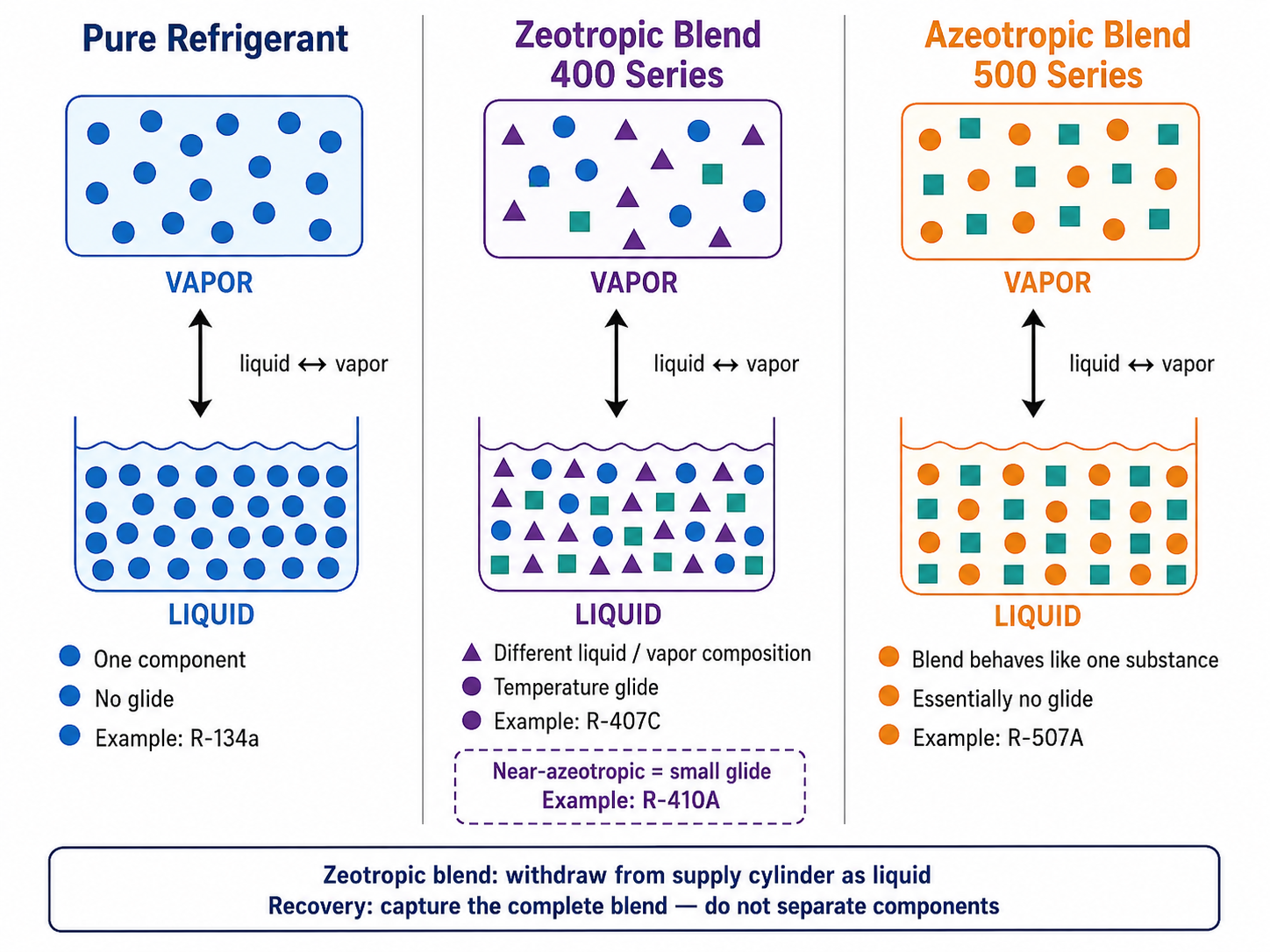
Figure 3.2.1 – Comparison of pure, zeotropic, and azeotropic refrigerant behavior.
AI-generated instructional figure: It may contain visual inaccuracies. Use the accompanying lesson text and cited authoritative sources to verify technical and regulatory details.
EPA 608 Exam Focus
What Students Must Remember
- A pure refrigerant contains one chemical compound.
- A refrigerant blend contains two or more components.
- 400 series → zeotropic blends.
- 500 series → azeotropic blends.
- Zeotropic blends can exhibit temperature glide.
- Zeotropic liquid and vapor phases can have different compositions.
- Fractionation means the composition of a blend changes because components are preferentially separated or lost.
- Zeotropic blends are normally withdrawn from the supply cylinder as liquid.
- Withdrawing as liquid does not mean uncontrolled liquid may enter a running compressor.
- A near-azeotropic blend is still a zeotropic blend.
- R-410A is a common near-azeotropic example but remains a 400-series blend.
- An azeotrope contains multiple chemicals even though it behaves much like a pure substance during phase change.
- Recovery should capture the complete blend; the technician should not separate blend components in the field.
- A leak does not automatically produce the same amount of fractionation in every system.
Typical Exam Question Patterns
Students may be asked to:
- Identify a 400-series refrigerant as zeotropic.
- Identify a 500-series refrigerant as azeotropic.
- Explain why a zeotropic blend is charged from the cylinder as liquid.
- Define fractionation.
- Determine whether near-azeotropic means azeotropic.
- Identify R-410A as a 400-series blend despite its small glide.
- Distinguish charging procedure from recovery procedure.
- Explain why individual components should not be added to correct a blend.
- Identify which blend type can show temperature glide.
High-Priority Comparison
| Exam Clue | Correct Concept |
|---|---|
| One chemical compound | Pure refrigerant |
| 400 series | Zeotropic blend |
| 500 series | Azeotropic blend |
| Liquid and vapor composition can differ | Zeotropic behavior |
| Temperature glide | Zeotropic behavior |
| Small glide but still 400 series | Near-azeotropic zeotrope |
| Composition change during selective phase loss | Fractionation |
| Preserve blend composition while charging | Withdraw zeotrope as liquid |
| Multiple components, essentially no glide at azeotropic composition | Azeotrope |
Common Mistakes and Confusing Points
Mistake 1: Assuming Every Blend Is Zeotropic
Some blends are azeotropic.
Use the refrigerant designation and technical data.
Mistake 2: Assuming Every 400-Series Blend Has Large Glide
Glide magnitude varies.
R-410A has very small glide but remains a 400-series zeotropic blend.
Mistake 3: Assuming “Near-Azeotropic” Means 500 Series
It does not.
Near-azeotropic describes small-glide zeotropic behavior.
Mistake 4: Calling an Azeotrope a Pure Refrigerant
An azeotrope still contains multiple chemical components.
It only behaves similarly to a pure substance during phase change at the azeotropic composition.
Mistake 5: Charging a Zeotropic Blend From the Cylinder as Vapor
Vapor withdrawal can change the composition of refrigerant delivered from the cylinder.
Withdraw the blend as liquid according to the applicable charging procedure.
Mistake 6: Interpreting Liquid Charging as Permission to Slug the Compressor
Liquid withdrawal from the cylinder and liquid entry into the compressor are different issues.
Meter or vaporize refrigerant as required by the service procedure.
Mistake 7: Assuming Every Leak Ruins a Blend
Fractionation depends on the blend, leak condition, amount lost, and whether liquid or vapor escapes.
Follow manufacturer guidance after significant loss.
Mistake 8: Trying to Correct a Fractionated Blend by Adding One Component
A field technician normally charges the specified refrigerant formulation, not individual blend components.
Mistake 9: Recovering Only One Phase Because the Refrigerant Is a Blend
Recovery should capture the complete remaining refrigerant charge using the required recovery procedure.
Mistake 10: Using One Saturation Temperature for Every Zeotropic Calculation
Zeotropic P-T data can require separate bubble-point and dew-point temperatures.
This is developed in Section 3.3.
Concept-Check Questions
Question 1
Which description best defines a pure refrigerant?
A. A refrigerant made from one chemical compound
B. Any refrigerant with zero ODP
C. Any refrigerant with a 500-series number
D. A blend that must always be charged as vapor
Question 2
Which ASHRAE refrigerant-number series is generally associated with zeotropic blends?
A. 100 series
B. 300 series
C. 400 series
D. 500 series
Question 3
Which ASHRAE refrigerant-number series is generally associated with azeotropic blends?
A. 200 series
B. 400 series
C. 500 series
D. 700 series
Question 4
What is fractionation?
A. Converting refrigerant vapor into liquid at constant pressure
B. Changing blend composition because components are preferentially separated, removed, or lost
C. Mixing compressor oil with refrigerant during normal circulation
D. Measuring pressure at two different points in a refrigeration system
Question 5
Why is a zeotropic refrigerant normally withdrawn from a supply cylinder as liquid when charging?
A. Liquid refrigerant always has lower pressure than vapor.
B. Liquid withdrawal guarantees that the compressor cannot receive liquid.
C. Liquid withdrawal helps preserve the specified blend composition.
D. Vapor cannot exist inside a refrigerant cylinder.
Question 6
Which statement about a near-azeotropic refrigerant such as R-410A is correct?
A. It is a pure refrigerant because its glide is small.
B. It is automatically assigned to the 500 series.
C. It contains only one chemical component.
D. It is a zeotropic blend with very small glide and remains in the 400 series.
Question 7
Which statement best describes recovery of a zeotropic refrigerant blend?
A. Recover only the least volatile component.
B. Recover the complete remaining blend using the proper recovery procedure rather than intentionally separating components.
C. Vent the vapor portion and recover only liquid.
D. Add individual components to the recovery cylinder until the original blend is restored.
Question 8
A technician sees the designation R-410A. Which conclusion is correct based on the numbering concepts in this section?
A. It is a 500-series azeotrope.
B. It is a single-component refrigerant.
C. It is a 400-series zeotropic blend even though its temperature glide is very small.
D. Its safety classification can be determined from the number 410 alone.
Answers and detailed explanations will be provided in
3.10 - Answers and Explanations.md.
Section Summary
Refrigerants can be single chemical compounds or blends.
A pure refrigerant:
- Contains one chemical compound.
- Does not fractionate into different refrigerant components.
- Has one saturation temperature at a specified saturation pressure.
A zeotropic blend:
- Contains two or more components.
- Is generally assigned a 400-series designation.
- Can have different liquid and vapor compositions.
- Can exhibit temperature glide.
- Can fractionate.
- Is normally withdrawn from a supply cylinder as liquid.
An azeotropic blend:
- Contains two or more components.
- Is generally assigned a 500-series designation.
- Behaves essentially like a single substance at the azeotropic composition.
- Has essentially no temperature glide at that condition.
A near-azeotropic blend:
- Is still a zeotropic blend.
- Has very small temperature glide.
- Does not become a 500-series azeotrope because its glide is small.
During recovery, the objective is to capture the complete remaining blend rather than intentionally separate its components.
The next section develops the concepts that make zeotropic service work different:
- Bubble point.
- Dew point.
- Temperature glide.
- Correct P-T chart interpretation.
See Section 3.3 - Temperature Glide Bubble Point and Dew Point.
References
Project Source
- Current EPA Section 608 teaching-material project outline, Module 3 — Refrigerants Blends and Lubricants, Section 3.2 learning scope and Figure 3.2.1 specification, reviewed August 7, 2026.
EPA 608 Teaching Source
- International Training Institute for the Sheet Metal and Air Conditioning Industry, EPA Section 608 Study Guide, glossary definition of zeotropic/non-azeotropic refrigerants and 400-series designation.
HVAC and Refrigeration References
-
Rex Miller and Mark R. Miller, HVAC Licensing Study Guide, 3rd ed., chapters on newer refrigerants, refrigerant blends, refrigerant composition, and azeotropic/zeotropic examples.
-
NCEES, PE Mechanical Reference Handbook, Version 2.0, 2025, Refrigeration section, ASHRAE-based refrigerant table identifying examples of single-component refrigerants and zeotropic blends.