3.5 - Refrigerant Lubricants
Technical source review date: August 7, 2026
Primary technical basis: Current project Module 3 outline, EPA Section 608 study guidance, HVAC licensing study guidance, and HVAC textbook references
Course role: Explains why compressor lubricant must be compatible with the refrigerant and equipment, how major lubricant families differ, and why moisture control and lubricant properties matter during service and retrofit work
Learning Objectives
After completing this section, a student should be able to:
- Identify the major refrigerant-lubricant families used in EPA 608 study material: mineral oil, alkylbenzene, polyolester, polyalkylene glycol, and polyalphaolefin.
- Explain why refrigerant-lubricant compatibility and miscibility affect oil return and compressor protection.
- Describe the especially important hygroscopic behavior of POE and PAG lubricants and the need for careful moisture control.
- Explain technician-level meanings of viscosity, dielectric strength, chemical stability, and oxidation resistance.
- Distinguish broad exam associations from actual equipment-specific lubricant requirements.
- Apply correct lubricant-handling principles during service, charging, recovery, and retrofit decisions.
Introduction
The compressor in a refrigeration system depends on lubricant to reduce:
- Friction.
- Wear.
- Heat generation.
- Metal-to-metal contact.
The lubricant also helps:
- Seal clearances.
- Carry heat away from moving surfaces.
- Protect bearings.
- Return through the refrigeration circuit when the system design requires oil circulation.
However, refrigeration lubricant does not work independently of the refrigerant.
Refrigerant and lubricant interact throughout the system.
Depending on the refrigerant and oil:
- They may mix readily.
- They may separate at some temperatures.
- Refrigerant may dilute the oil.
- Oil may travel through the evaporator and condenser.
- Oil return to the compressor may become easier or more difficult.
- Moisture may be absorbed into the lubricant.
- Chemical reactions may form acids or sludge.
For this reason:
The correct lubricant is not selected by oil type alone. It must be compatible with the refrigerant, compressor, system design, and manufacturer requirements.
The current project outline specifically requires this section to cover:
- Mineral oil.
- Alkylbenzene.
- Polyolester.
- Polyalkylene glycol.
- Polyalphaolefin.
- Compatibility.
- Hygroscopic behavior.
- Proper storage.
- Viscosity.
- Miscibility.
- Dielectric strength.
- Oxidation resistance.
Key Concepts
1. Lubricant Is Part of the Refrigeration System
A compressor lubricant performs more than one function.
Important functions include:
- Reducing friction between moving parts.
- Reducing wear.
- Helping form a sealing film.
- Carrying heat away from bearings and moving surfaces.
- Helping protect surfaces against chemical or mechanical damage.
Refrigeration oil must:
- Remain useful even when diluted with refrigerant.
- Have suitable low-temperature miscibility where required.
- Provide electrical insulating properties.
- Maintain stability.
- Help provide a pressure seal.
These are not independent properties.
Changing one characteristic can affect another.
2. Refrigerant and Lubricant Must Work Together
The refrigerant and lubricant form a working pair.
A lubricant that works well with one refrigerant may not work correctly with another.
Possible problems from an incompatible combination include:
- Poor oil return.
- Excessive dilution.
- Oil separation.
- Loss of lubrication.
- Bearing damage.
- Compressor wear.
- Chemical breakdown.
- Sludge or acid formation.
- Seal or material problems.
- Reduced compressor life.
Therefore:
Do not select compressor oil only because its viscosity appears similar to the original oil.
The complete refrigerant-lubricant-equipment combination must be approved.
3. Broad EPA 608 Exam Associations
The following broad study associations are used in this course:
| Lubricant Type | Common Abbreviation | Broad Study-Guide Association |
|---|---|---|
| Mineral oil | MO | CFC refrigerant systems |
| Alkylbenzene | AB | R-22 and other refrigerant systems |
| Polyolester | POE | HFC refrigerant systems |
| Polyalkylene glycol | PAG | R-134a automotive systems |
| Polyalphaolefin | PAO | R-717 ammonia refrigeration systems |
These are useful exam-preparation associations.
They are not universal compatibility rules.
Actual equipment may require:
- A particular lubricant chemistry.
- A particular viscosity grade.
- A particular additive package.
- A specific compressor-manufacturer approval.
For service work:
Use the equipment and compressor manufacturer’s lubricant specification.
Mineral Oil
1. Description
Mineral oil (MO) is a petroleum-based lubricant historically associated with many CFC and HCFC refrigeration systems.
It was widely used with refrigerants such as:
- R-12.
- R-22.
- Other older halocarbon refrigerants where approved.
A common exam association is:
Mineral Oil — MO — CFC refrigerant systems
as a basic exam association.
2. Strengths
Mineral oil has historically provided:
- Good lubrication.
- Familiar service behavior.
- Adequate stability when properly selected.
- Long service history in older refrigeration equipment.
3. Important Limitation With Many HFC Applications
A key retrofit issue is that traditional mineral oil may have poor miscibility with many HFC refrigerants.
If the oil does not travel properly with the refrigerant:
- Oil can remain in the evaporator.
- Oil can accumulate in piping.
- Compressor oil level can decrease.
- Heat-transfer performance can be affected.
In many applications, mineral-oil-based lubricants used with CFC systems cannot be used with newer refrigerants, and POE or alkylbenzene lubricants may be required depending on the application.
4. Technician Rule
Do not assume:
old refrigerant replaced
→ old mineral oil automatically remains acceptable
Lubricant compatibility must be part of the retrofit decision.
Detailed retrofit procedure is developed in Section 3.7 - Retrofitting and Substitute Refrigerants.
Alkylbenzene
1. Description
Alkylbenzene (AB) is a synthetic hydrocarbon lubricant used in many refrigeration applications.
A common broad association is:
Alkylbenzene — AB — R-22 and other refrigerant systems
2. Why Alkylbenzene Is Important
Alkylbenzene has been used where improved refrigerant-oil behavior is desired compared with some traditional mineral oils.
It has appeared in:
- R-22 systems.
- Retrofit applications.
- Refrigerant blends where approved.
- Applications requiring better low-temperature behavior.
3. Compatibility Is Still Equipment Specific
The fact that AB may work with R-22 or certain blends does not mean:
- Every R-22 system should be converted to AB.
- AB is compatible with every HFC.
- AB can replace POE automatically.
- AB can be mixed with any existing oil without limits.
Use the compressor and refrigerant manufacturer’s instructions.
4. Mineral Oil and Alkylbenzene Are Not the Same Oil
Both may appear in older refrigeration systems, but they are different lubricant chemistries.
A technician should identify:
- Existing lubricant.
- New refrigerant requirement.
- Allowable residual oil.
- Required oil-change procedure.
before a retrofit.
Polyolester
1. Description
Polyolester (POE) is a synthetic ester lubricant widely associated with HFC refrigerants and many newer refrigerant applications.
A common broad study association is:
Polyolester — POE — HFC refrigerant systems
as a principal study association.
Traditional mineral oils and alkylbenzenes do not mix adequately with HFC refrigerants in many applications, so POE lubricants are often used instead.
2. POE and Refrigerant Compatibility
POE is commonly used because it can provide the refrigerant-oil miscibility needed for oil circulation and return in systems using refrigerants for which mineral oil is unsuitable.
However:
POE is not one universal lubricant.
Different POE products can differ in:
- Viscosity.
- Additives.
- Chemical formulation.
- Compressor approval.
- Refrigerant compatibility.
Use the specified product or approved equivalent.
3. POE Is Highly Moisture Sensitive
One of the most important service characteristics of POE is its strong tendency to absorb moisture.
POE and PAG lubricants absorb and retain moisture to a much greater extent than traditional lubricants.
This matters because moisture can contribute to:
- Acid formation.
- Corrosion.
- Lubricant degradation.
- Compressor damage.
- Problems that cannot be removed simply by a short vacuum procedure.
4. Moisture Can Become Dissolved in POE
Water can be present in different forms.
Some moisture may be:
- Free moisture.
- Dissolved or absorbed in the lubricant.
Deep vacuum can remove free water but may not readily remove water that has been absorbed into the lubricant.
Therefore:
Preventing moisture entry is more effective than trying to remove large amounts of absorbed moisture later.
Polyalkylene Glycol
1. Description
Polyalkylene glycol (PAG) is a synthetic lubricant strongly associated with mobile air-conditioning applications.
A common broad association is:
PAG — R-134a automotive systems
Automotive air-conditioning systems may use PAG lubricants, and PAG is typically not the normal lubricant used in stationary equipment.
2. PAG Is Not Automatically Appropriate for Stationary Equipment
A common error is:
R-134a system
→ PAG must always be used
That is incorrect.
R-134a has been used in:
- Automotive air conditioning.
- Appliances.
- Commercial refrigeration.
- Chillers.
Lubricant requirements depend on the application and compressor design.
3. PAG Is Hygroscopic
PAG, like POE, is strongly moisture sensitive.
POE and PAG are often grouped together as lubricants that absorb moisture much more strongly than traditional mineral oils.
Therefore:
- Keep containers tightly closed.
- Minimize exposure to air.
- Do not leave service containers open.
- Use clean, dry transfer equipment.
- Do not return exposed or contaminated lubricant to a clean stock container.
Polyalphaolefin
1. Description
Polyalphaolefin (PAO) is a synthetic hydrocarbon lubricant.
A common broad association is:
PAO — R-717 ammonia refrigeration systems
This is useful as a study-guide association.
2. Ammonia Has Different Oil Behavior
Some refrigerants, including ammonia, do not mix readily with oil.
This means oil management in ammonia systems may differ substantially from halocarbon systems.
Oil may:
- Separate from refrigerant.
- Collect at low points.
- Require oil management or oil-return provisions specific to system design.
Therefore, PAO should not be treated simply as “the ammonia version of POE.”
3. Manufacturer Requirements Control
Large ammonia refrigeration systems can use different compressor designs and lubricant specifications.
For service work:
- Follow compressor-manufacturer requirements.
- Follow system-designer requirements.
- Do not substitute oil based only on the refrigerant designation.
Refrigerant-Lubricant Compatibility
1. Compatibility Is Broader Than “Will the Two Mix?”
A refrigerant-lubricant pair must be evaluated for more than simple miscibility.
Compatibility can involve:
- Lubrication quality.
- Viscosity after refrigerant dilution.
- Oil return.
- Material compatibility.
- Chemical stability.
- Temperature range.
- Compressor type.
- Electrical characteristics.
- Seal compatibility.
A lubricant can be miscible and still be unsuitable for a particular compressor.
2. Refrigerant Dilution Changes Oil Behavior
Refrigerant can dissolve in compressor oil.
This can reduce lubricant viscosity.
If the oil becomes too thin:
- The lubricating film can weaken.
- Bearings can wear.
- Sliding surfaces may not remain separated.
- Compressor reliability can decrease.
Solubility affects how much the refrigerant thins the oil, and excessive thinning can reduce protection.
3. Oil Return Is Essential
Oil that leaves the compressor must return.
If too much oil becomes trapped in:
- Evaporator.
- Suction piping.
- Heat exchangers.
- Low-velocity piping.
the compressor can become oil-starved.
Miscibility affects whether oil and refrigerant remain together or separate, and poor oil return can leave the compressor without enough lubricant.
4. Too Much Refrigerant-Oil Mixing Can Also Create Problems
Easy mixing is not always beneficial.
If refrigerant dissolves strongly in oil during the off cycle:
- Oil can become diluted.
- Foaming may occur during startup.
- Oil may be carried out of the compressor rapidly.
Therefore, good system behavior requires the right degree of interaction, not simply “maximum mixing.”
Miscibility
1. Definition
Miscibility is the ability of refrigerant and lubricant to mix rather than separate into distinct liquid phases.
Low-temperature miscibility is especially important because oil and refrigerant must often remain compatible in cold portions of the refrigeration circuit.
2. Why Miscibility Matters
If oil separates from refrigerant in the wrong part of the system:
- Oil can remain in the evaporator.
- Heat transfer can be reduced.
- Oil return to the compressor can become poor.
- Compressor lubrication can eventually become inadequate.
3. Miscibility Depends on Temperature and Composition
A refrigerant-lubricant pair may be:
- Fully miscible over one temperature range.
- Partly miscible over another.
- Separated at low or high temperatures.
Therefore, the question is not simply:
Do they mix?
A better question is:
Do they remain acceptably miscible over the system's required temperature and concentration range?
4. Miscibility and Solubility Are Related but Not Identical
At technician level:
- Miscibility concerns whether the liquids mix into one phase.
- Solubility concerns how much refrigerant dissolves in the lubricant and how the mixture behaves.
Both can affect oil viscosity and return.
Hygroscopic Behavior
1. Meaning
A hygroscopic lubricant attracts or absorbs moisture from the surrounding environment.
Refrigeration oils are hygroscopic.
For technician practice, the most important distinction is that:
POE and PAG are especially moisture sensitive compared with traditional mineral-oil lubricants.
2. Why Moisture Matters
Moisture in lubricant can contribute to:
- Acid formation.
- Corrosion.
- Lubricant breakdown.
- Copper plating.
- Motor-winding damage.
- Bearing damage.
- Sludge.
- Reduced dielectric quality.
- Freeze-up at restrictions in some systems.
These contamination effects are developed further in Section 3.6 - Moisture Acid and Noncondensables.
3. POE Moisture Is Especially Important
POE can absorb moisture quickly from humid air.
Therefore, unnecessary exposure should be minimized.
Technicians should avoid:
- Leaving the cap off.
- Pouring oil into an open container and leaving it uncovered.
- Using wet funnels or transfer equipment.
- Returning used lubricant to a new-oil container.
Proper Lubricant Storage and Handling
1. Keep Containers Closed
Good practice is:
Open only when needed
→ dispense required amount
→ close immediately
This is especially important for POE and PAG.
2. Use Clean, Dry Equipment
Transfer equipment should be:
- Clean.
- Dry.
- Appropriate for the lubricant.
- Protected from refrigerant or oil cross-contamination.
3. Label Lubricant Clearly
The container should identify:
- Oil type.
- Viscosity grade.
- Manufacturer/product where required.
- Whether the oil is new or used.
Do not rely on:
- Oil color.
- Bottle shape.
- Memory.
4. Do Not Mix Lubricants Unless Approved
Different oils should not be mixed casually.
Mixing can change:
- Viscosity.
- Additive balance.
- Miscibility.
- Moisture behavior.
- Chemical stability.
Some retrofit procedures intentionally allow limited residual original oil, but that is different from assuming that arbitrary oil mixing is acceptable.
5. Keep Used Oil Separate
Used compressor oil may contain:
- Moisture.
- Acid.
- Metal particles.
- Burnout residue.
- Refrigerant.
- Other contaminants.
Do not return used oil to a clean supply container.
Viscosity
1. Definition
Viscosity is the resistance of a fluid to flow.
At technician level, it is often described as the oil’s thickness.
A useful technician-level description is:
2. Why Viscosity Matters
The oil must be thick enough to:
- Maintain a lubricating film.
- Separate moving surfaces.
- Protect bearings.
But it must also flow adequately through:
- Bearings.
- Oil passages.
- Pumps.
- Compressor clearances.
3. Temperature Changes Viscosity
In general:
Higher oil temperature
→ lower viscosity

Lower oil temperature
→ higher viscosity
Therefore, oil must remain usable over the compressor’s expected temperature range.
4. Refrigerant Can Reduce Effective Viscosity
When refrigerant dissolves in oil, the mixture may become thinner.
Therefore:
The viscosity printed on a container is not the only viscosity condition experienced inside a compressor.
The refrigerant-lubricant mixture must provide adequate lubrication under actual operating conditions.
5. Use the Specified Viscosity Grade
Do not substitute:
a thicker oil
because it “should lubricate better.”
An oil that is too viscous can:
- Flow poorly.
- Increase losses.
- Interfere with oil return.
An oil that is too thin can:
- Fail to maintain the oil film.
- Increase wear.
Use the specified grade.
Dielectric Strength
1. Definition
Dielectric strength describes the ability of an insulating material to resist electrical breakdown.
For refrigeration lubricant:
Higher dielectric strength means the oil can withstand a stronger electric field before it begins to conduct electrically.
Electrical insulating properties are an important refrigerant-oil characteristic.
2. Why It Matters in Hermetic Compressors
In a hermetic compressor:
- The electric motor is inside the refrigerant system.
- Motor windings can contact refrigerant and lubricant.
- The fluid environment must not promote electrical conduction or insulation failure.
Therefore, lubricant cleanliness and moisture control are especially important.
3. Moisture and Contamination Can Reduce Electrical Quality
Contaminants can degrade the insulating performance of the oil.
Possible contaminants include:
- Water.
- Acid.
- Metal particles.
- Carbonized burnout residue.
This is another reason not to reuse suspect lubricant without an approved procedure.
Chemical Stability and Oxidation Resistance
1. Chemical Stability
Chemical stability is the lubricant’s ability to continue performing without harmful chemical breakdown.
A stable lubricant should resist formation of:
- Acids.
- Sludge.
- Deposits.
- Carbonaceous material.
Good chemical stability helps prevent acids, sludge, blocked tubing, and carbon deposits.
2. Oxidation Resistance
Oxidation resistance is the lubricant’s ability to resist harmful reaction with oxygen and the formation of degradation products.
Oxidation resistance refers to the oil’s ability to resist sludge accumulation.
At technician level:
Good oxidation resistance
→ less tendency to form sludge and degradation products
3. Heat Accelerates Lubricant Degradation
High temperature can accelerate:
- Oxidation.
- Chemical breakdown.
- Formation of deposits.
- Viscosity change.
Compressor overheating can therefore damage both:
- Mechanical components.
- Lubricant quality.
4. Acid and Burnout Contamination
A motor burnout can produce:
- Acid.
- Carbon.
- Sludge.
- Degraded lubricant.
The oil from a burned compressor should not be treated as ordinary reusable lubricant.
Burnout cleanup and contamination control are developed later in the course.
Lubricant Comparison
| Lubricant | Abbreviation | Broad EPA Study Association | Major Technician Reminder |
|---|---|---|---|
| Mineral oil | MO | CFC systems | Common in older systems; many HFC retrofits require another lubricant |
| Alkylbenzene | AB | R-22 and other systems | Useful in selected HCFC/retrofit applications; verify approval |
| Polyolester | POE | HFC systems | Strong moisture sensitivity; widely used with modern stationary refrigerants |
| Polyalkylene glycol | PAG | R-134a automotive | Strong moisture sensitivity; common in MVAC, not a universal stationary lubricant |
| Polyalphaolefin | PAO | R-717 ammonia | Synthetic hydrocarbon; ammonia oil-management requirements are system specific |
Do not use this table as a universal substitution chart. Manufacturer requirements control actual lubricant selection.
Technician Selection Process
A practical decision sequence is:
Identify refrigerant
↓
Identify compressor / equipment requirement
↓
Identify required lubricant chemistry
↓
Identify required viscosity grade
↓
Confirm approved product
↓
Check existing lubricant and retrofit history
↓
Prevent moisture and cross-contamination
↓
Charge only the specified lubricant quantity
If Information Conflicts
If:
- Nameplate information.
- Retrofit label.
- Service records.
- Oil container.
- Manufacturer documentation.
do not agree:
Stop and verify before adding oil.
Adding the wrong oil can be more damaging than operating briefly with the correct oil level slightly low while the proper service information is obtained.
Technical Details
1. Refrigerant-Oil Relationship
The refrigeration system must allow enough oil to:
- Remain available to lubricate the compressor.
- Circulate where the design expects it to circulate.
- Return to the compressor.
Oil behavior is affected by:
- Refrigerant solubility.
- Miscibility.
- Refrigerant velocity.
- Piping design.
- Temperature.
- Compressor design.
2. Oil Level Is Not Controlled by Chemistry Alone
Even a chemically compatible oil can fail to return if:
- Piping is poorly designed.
- Refrigerant velocity is too low.
- Oil traps are incorrect.
- The system operates outside design conditions.
Therefore, lubricant compatibility is necessary but not sufficient for good oil management.
3. Electrical Property Is Particularly Important for Hermetics
In open-drive compressors, the motor is outside the refrigerant circuit.
In hermetic and semi-hermetic compressors, electrical components are exposed to the internal refrigerant-oil environment.
Therefore:
- Moisture.
- Acid.
- Conductive contamination.
can have direct electrical consequences.
4. Lubricant Quantity Matters
Too little oil can cause:
- Loss of lubrication.
- Bearing wear.
- Compressor failure.
Too much oil can:
- Reduce heat-transfer performance.
- Accumulate in heat exchangers.
- Affect system operation.
Do not add oil merely because some oil was removed during recovery unless the service procedure requires a measured replacement.
5. Retrofit Work Requires Lubricant Planning
When changing refrigerants, the technician may need to determine:
- Whether the original oil can remain.
- Whether oil must be changed.
- How much residual original oil is allowed.
- Whether filter-driers must be replaced.
- Whether seals or other materials are compatible.
- Whether the compressor manufacturer approves the new combination.
Those details are addressed in Section 3.7.
Important Terms
Alkylbenzene
Alkylbenzene (AB) is a synthetic hydrocarbon refrigeration lubricant commonly associated in EPA 608 study material with R-22 and selected other refrigerant systems.
Chemical Stability
Chemical stability is the ability of a lubricant to resist harmful chemical breakdown during service.
Dielectric Strength
Dielectric strength is the ability of an insulating material to resist electrical breakdown under an applied electric field.
Hygroscopic
Hygroscopic describes a material that attracts or absorbs moisture from the surrounding environment.
Lubricant Compatibility
Lubricant compatibility means that the lubricant, refrigerant, compressor, system materials, and operating conditions can work together without unacceptable lubrication, chemical, or performance problems.
Mineral Oil
Mineral oil (MO) is a petroleum-based refrigeration lubricant historically associated with many CFC and HCFC systems.
Miscibility
Miscibility is the ability of two liquids, such as refrigerant and oil, to mix into a single liquid phase over specified conditions.
Oxidation Resistance
Oxidation resistance is the ability of a lubricant to resist oxidation and the formation of harmful degradation products such as sludge.
Polyalkylene Glycol
Polyalkylene glycol (PAG) is a synthetic lubricant widely associated with R-134a mobile air-conditioning applications.
Polyalphaolefin
Polyalphaolefin (PAO) is a synthetic hydrocarbon lubricant broadly associated in course study material with R-717 ammonia refrigeration applications.
Polyolester
Polyolester (POE) is a synthetic ester lubricant widely used with HFC and many newer stationary refrigeration applications and is especially sensitive to moisture exposure.
Solubility
Solubility, in this context, describes how refrigerant dissolves in lubricant and influences lubricant properties such as viscosity.
Viscosity
Viscosity is a fluid’s resistance to flow.
Figures and Diagrams
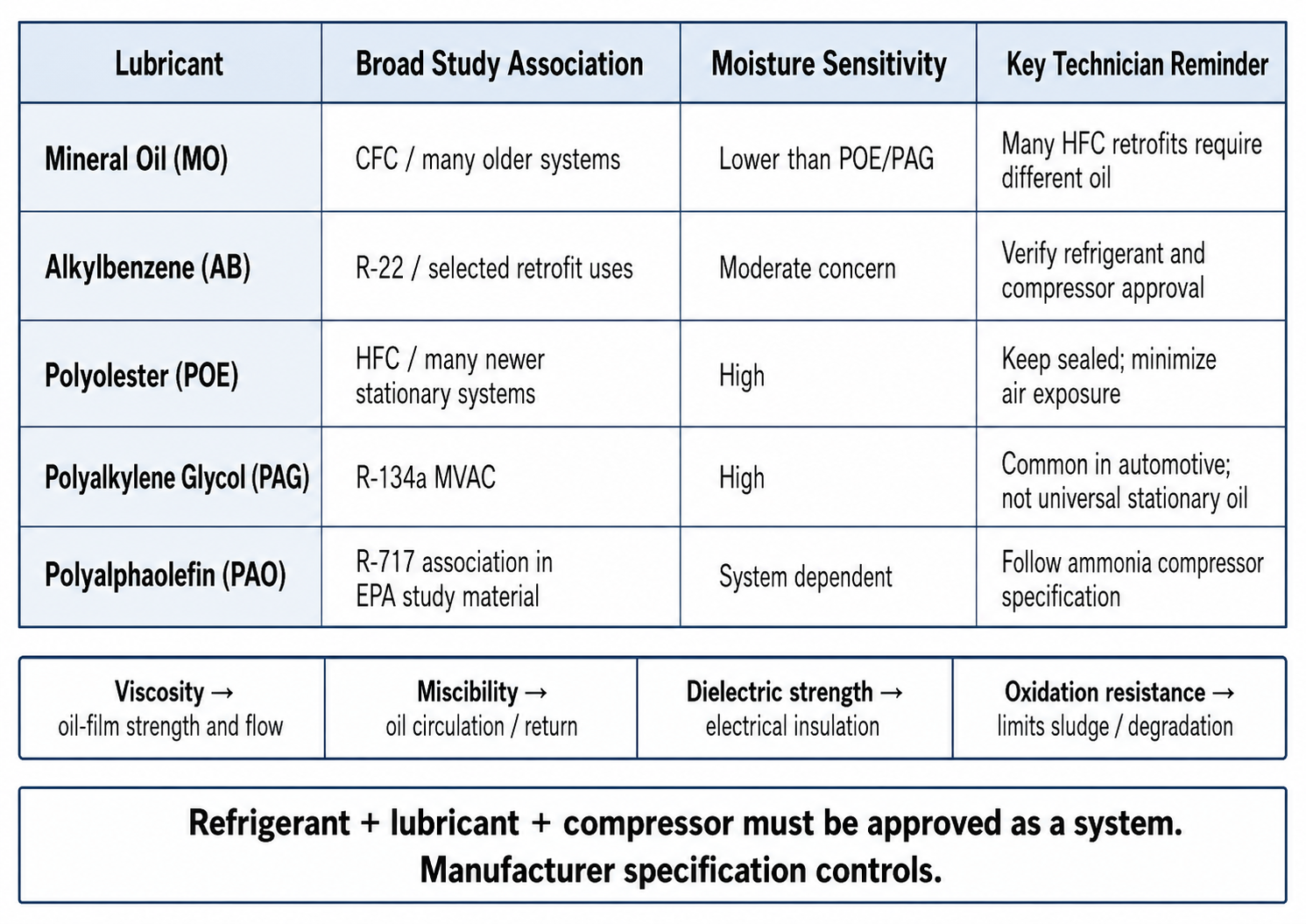
Figure 3.5.1 – Refrigerant lubricant families, broad compatibility associations, and key technician handling considerations.
AI-generated instructional figure: It may contain visual inaccuracies. Use the accompanying lesson text and cited authoritative sources to verify technical and regulatory details.
EPA 608 Exam Focus
What Students Must Remember
- MO → mineral oil → broad CFC-system association.
- AB → alkylbenzene → broad R-22/selected-system association.
- POE → polyolester → broad HFC-system association.
- PAG → polyalkylene glycol → strong automotive R-134a association.
- PAO → polyalphaolefin → broad R-717 association in course study material.
- POE and PAG are especially hygroscopic.
- Keep moisture-sensitive oils sealed and minimize exposure to air.
- Viscosity describes resistance to flow.
- Refrigerant dissolved in oil can reduce effective viscosity.
- Miscibility affects whether refrigerant and oil remain mixed and whether oil can return properly.
- Poor oil return can starve the compressor.
- Excessive dilution can weaken lubrication.
- Dielectric strength is important for electrical insulation, especially in hermetic compressors.
- Good chemical stability and oxidation resistance reduce the formation of acids, sludge, and deposits.
- Broad oil/refrigerant associations are not universal substitution rules.
- Manufacturer lubricant specifications control actual service work.
Typical Exam Question Patterns
Students may be asked to:
- Match POE with HFC refrigerant systems.
- Match PAG with automotive R-134a applications.
- Identify mineral oil as a common lubricant in older CFC systems.
- Identify alkylbenzene as associated with R-22 and selected retrofit applications.
- Identify the most moisture-sensitive lubricant choices.
- Define miscibility.
- Define viscosity.
- Explain why poor miscibility can affect oil return.
- Explain why refrigerant dilution can reduce oil-film protection.
- Identify dielectric strength as an electrical-insulation property.
- Identify oxidation resistance as resistance to sludge and degradation.
- Choose manufacturer instructions over a generic oil substitution rule.
High-Priority Lubricant Table
| Exam Clue | Correct Concept |
|---|---|
| CFC systems | Mineral oil |
| R-22 / selected systems | Alkylbenzene |
| HFC systems | POE |
| R-134a MVAC | PAG |
| R-717 association | PAO |
| Attracts/absorbs moisture | Hygroscopic |
| Resistance to flow | Viscosity |
| Refrigerant and oil stay mixed | Miscibility |
| Electrical insulation property | Dielectric strength |
| Resists sludge/degradation | Oxidation resistance |
Common Mistakes and Confusing Points
Mistake 1: Treating the Lubricant Table as a Universal Compatibility Chart
The table is a study aid.
Actual compressor specifications control.
Mistake 2: Assuming All R-134a Systems Use PAG
PAG is strongly associated with automotive R-134a systems.
Stationary R-134a systems often use different lubricants.
Mistake 3: Assuming All HFC Systems Use the Same POE
POE is a lubricant family.
Viscosity grade and formulation can differ.
Mistake 4: Assuming Mineral Oil Is Acceptable Because It Worked With the Old Refrigerant
A retrofit may require another lubricant.
Mistake 5: Ignoring Moisture Exposure
POE and PAG can absorb significant moisture from air.
Keep containers closed.
Mistake 6: Treating Miscibility as the Same as Viscosity
They are different properties.
- Miscibility → ability of oil and refrigerant to mix.
- Viscosity → resistance to flow.
Mistake 7: Assuming More Miscibility Is Always Better
Too little miscibility can hurt oil return.
Strong refrigerant solubility can also thin the oil and affect lubrication.
Mistake 8: Choosing a Thicker Oil “for Better Protection”
An oil that is too thick may not flow correctly.
Use the specified viscosity grade.
Mistake 9: Ignoring Dielectric Strength in Hermetic Compressors
The lubricant is part of the electrical environment surrounding the internal motor.
Moisture and contamination can reduce insulation quality.
Mistake 10: Mixing Lubricants Without Approval
Mixing can alter:
- Viscosity.
- Additives.
- Miscibility.
- Stability.
Only mix lubricants when the approved service procedure permits it.
Concept-Check Questions
Question 1
Which lubricant is broadly associated with many HFC refrigerant systems in common EPA 608 study material?
A. Mineral oil
B. Polyolester
C. Polyalphaolefin
D. Silicone brake fluid
Question 2
Which lubricant is strongly associated with R-134a automotive air-conditioning systems?
A. PAG
B. Mineral oil
C. PAO
D. Water-glycol solution
Question 3
What does lubricant viscosity describe?
A. The refrigerant’s ozone-depletion potential
B. The amount of moisture in the refrigerant
C. The lubricant’s resistance to flow
D. The electrical voltage supplied to the compressor
Question 4
Why is refrigerant-lubricant miscibility important?
A. It determines the refrigerant cylinder color.
B. It affects oil circulation and return to the compressor.
C. It determines the EPA certification type.
D. It prevents refrigerant from changing phase.
Question 5
Which statement about POE and PAG lubricants is correct?
A. They are especially sensitive to moisture exposure.
B. They cannot absorb moisture.
C. They are interchangeable in every refrigeration system.
D. They should be stored in open containers to release moisture.
Question 6
What does high dielectric strength indicate about a refrigeration lubricant?
A. It resists electrical breakdown and supports insulation performance.
B. It always has very high viscosity.
C. It guarantees complete miscibility with every refrigerant.
D. It means the oil contains no additives.
Question 7
Which statement best describes oxidation resistance?
A. The ability of the oil to raise refrigerant pressure
B. The ability of the oil to resist sludge and chemical degradation caused by oxidation
C. The ability of the oil to evaporate with refrigerant
D. The ability of the oil to change a zeotropic blend into an azeotrope
Question 8
A technician is replacing a refrigerant and sees that a study table associates the new refrigerant family with POE. What is the best next step before adding lubricant?
A. Add any available POE because all POE oils are interchangeable.
B. Mix POE with the existing lubricant until the viscosity looks correct.
C. Verify the compressor or equipment manufacturer’s required lubricant type and viscosity grade.
D. Add mineral oil first and then POE if oil return is poor.
Answers and detailed explanations will be provided in
3.10 - Answers and Explanations.md.
Section Summary
Refrigeration lubricant must:
- Protect moving parts.
- Maintain an adequate oil film.
- Remain chemically stable.
- Work with the refrigerant.
- Circulate and return as required by the system.
- Maintain appropriate electrical properties in hermetic equipment.
The major lubricant families in the project are:
MO  → Mineral Oil
AB  → Alkylbenzene
POE → Polyolester
PAG → Polyalkylene Glycol
PAO → Polyalphaolefin
Broad EPA study associations are:
MO  → CFC systems
AB  → R-22 and selected systems
POE → HFC systems
PAG → R-134a automotive
PAO → R-717 association
These associations are useful for exam preparation but do not replace manufacturer requirements.
Important lubricant properties include:
- Viscosity — resistance to flow.
- Miscibility — ability of refrigerant and oil to remain mixed.
- Dielectric strength — resistance to electrical breakdown.
- Chemical stability — resistance to harmful breakdown.
- Oxidation resistance — resistance to sludge and degradation.
POE and PAG deserve special attention because of their strong moisture sensitivity.
Good service practice is:
Use the specified oil
Keep it clean
Keep it dry
Keep containers closed
Do not mix oils without approval
The next section develops what happens when moisture, acid, and noncondensable gases contaminate the refrigeration system.
See Section 3.6 - Moisture Acid and Noncondensables.
References
Project Source
- Current EPA Section 608 teaching-material project outline, Module 3 — Refrigerants Blends and Lubricants, Section 3.5. The required scope includes mineral oil, alkylbenzene, polyolester, polyalkylene glycol, polyalphaolefin, compatibility, hygroscopic behavior, proper storage, viscosity, miscibility, dielectric strength, and oxidation resistance. Reviewed August 7, 2026.
EPA Section 608 Study Source
- International Training Institute for the Sheet Metal and Air Conditioning Industry, EPA Section 608 Study Guide, Core section. The guide provides the MO/CFC, AB/R-22, POE/HFC, PAG/R-134a automotive, and PAO/R-717 study associations and defines viscosity, miscibility, dielectric strength, oxidation value, and other lubricant properties.
HVAC Licensing Reference
-
Rex Miller and Mark R. Miller, HVAC Licensing Study Guide, 3rd ed., Chapter 12 — EPA-Refrigerant Reclaimers. The text discusses lubricant viscosity, lubricity, chemical stability, miscibility, solubility, oil return, POE/PAG moisture absorption, R-134a lubricant considerations, and retrofit implications.
-
Rex Miller and Mark R. Miller, HVAC Licensing Study Guide, 3rd ed., Chapter 6 — Refrigerants. The text discusses refrigerant-oil mixing, oil return, foaming, and the advantages and disadvantages of refrigerant-oil miscibility.
HVAC Textbook Reference
- Edward G. Pita, Air Conditioning Principles and Systems: An Energy Approach, 4th ed., refrigerant-substitution discussion. The text notes that mineral-oil-based lubricants used with older CFC systems may not be suitable with some newer refrigerants and that alternate lubricants such as POE or alkylbenzene may be required.