3.1 - Refrigerant Properties and Phase Change
Technical source review date: August 7, 2026
Primary technical basis: Project Module 3 outline, EPA 608 study material, and HVAC/refrigeration textbooks
Course role: Introduces the thermodynamic behavior that allows refrigerants to absorb and reject large amounts of heat through controlled evaporation and condensation
Learning Objectives
After completing this section, a student should be able to:
- Define a refrigerant as a heat-transfer fluid and explain why phase change is useful in refrigeration.
- Distinguish sensible heat from latent heat at the technician level.
- Define saturation temperature and saturation pressure.
- Explain how pressure changes the saturation temperature of a refrigerant.
- Distinguish evaporation from condensation and identify the direction of heat transfer in each process.
- Determine whether a pure refrigerant is subcooled liquid, saturated, or superheated vapor when its temperature is compared with its saturation temperature at the same pressure.
Introduction
A refrigeration system does not create cold. It moves heat.
The refrigerant is the working fluid that makes this heat transfer practical. In a typical vapor-compression refrigeration system, refrigerant repeatedly changes between liquid and vapor while circulating through the equipment.
Two phase-change processes are especially important:
- Evaporation: liquid refrigerant absorbs heat and becomes vapor.
- Condensation: refrigerant vapor rejects heat and becomes liquid.
These processes transfer much more energy than would normally be transferred by a small temperature change of the same mass of refrigerant. This is why latent heat and saturation are fundamental to refrigeration.
For EPA Section 608 preparation, a technician must be able to recognize:
- Whether refrigerant is liquid, vapor, or a liquid-vapor mixture.
- Whether the refrigerant is absorbing or rejecting heat.
- How pressure affects boiling and condensing temperature.
- Why lowering pressure can make refrigerant boil at a lower temperature.
- Why raising pressure allows refrigerant to condense at a higher temperature.
The complete vapor-compression cycle, system components, gauge pressures, and pressure-temperature chart procedures are developed in Module 4. This section establishes the refrigerant-property foundation needed for those topics.
Key Concepts
1. Refrigerant Is a Heat-Transfer Fluid
A refrigerant is a substance used to transfer heat in refrigeration and air-conditioning equipment.
In a basic vapor-compression system, refrigerant performs two major heat-transfer jobs:
- It absorbs heat while evaporating at the low-pressure side of the system.
- It rejects heat while condensing at the high-pressure side of the system.
The refrigerant is useful because its pressure can be controlled so that its boiling and condensing temperatures occur at temperatures useful for refrigeration and air conditioning.
A simplified relationship is:
Lower refrigerant pressure
→ lower saturation temperature
→ refrigerant can boil while absorbing heat from a colder space
and:
Higher refrigerant pressure
→ higher saturation temperature
→ refrigerant can condense while rejecting heat to warmer surroundings
This relationship is one of the most important concepts in refrigeration.
2. Heat Transfer Does Not Require a Change in Temperature
Students often associate heat transfer only with a temperature change. Refrigerants demonstrate why that idea is incomplete.
Heat added to or removed from a substance can produce:
- A temperature change without a phase change, or
- A phase change without the same kind of temperature change.
These two forms of energy transfer are described as:
- Sensible heat
- Latent heat
The distinction is important because much of the useful heat transfer in an evaporator and condenser occurs during phase change.
3. Sensible Heat
Sensible heat is heat added to or removed from a substance that changes its temperature without changing its phase.
For a single-phase substance over a range where the specific heat can be treated as approximately constant:
where:
- = sensible heat transferred.
- = mass of the substance.
- = specific heat at approximately constant pressure.
- = temperature change.
The examination normally emphasizes the physical meaning more than detailed sensible-heat calculations.
Example
Suppose liquid refrigerant remains entirely liquid while its temperature rises.
The refrigerant:
- Gains energy.
- Becomes warmer.
- Does not yet boil.
This is a sensible heat increase.
Likewise, if superheated refrigerant vapor cools but remains vapor, it experiences a sensible temperature decrease.
4. Latent Heat
Latent heat is the energy associated with a change of phase.
For the liquid-vapor phase change:
where:
- = latent heat transferred.
- = mass changing phase.
- = latent heat of vaporization at the applicable saturation condition.
During vaporization:
- Refrigerant absorbs energy.
- Liquid becomes vapor.
During condensation:
- Refrigerant rejects energy.
- Vapor becomes liquid.
For the same saturation condition, the magnitude of the latent heat released during condensation corresponds to the latent heat required for vaporization in the reverse process.
5. Why Latent Heat Is So Useful in Refrigeration
A refrigerant can absorb a substantial amount of heat while boiling.
This allows the evaporator to remove heat from:
- Indoor air.
- Refrigerated food.
- A cold-storage space.
- Water in a chiller.
- A process stream.
The refrigerant then carries that energy through the system. In the condenser, the refrigerant rejects heat while changing from vapor to liquid.
At the technician level, remember:
Evaporation absorbs heat. Condensation rejects heat.
This statement describes the refrigerant’s heat-transfer behavior.
6. Evaporation
Evaporation, also called vaporization in this context, is the phase change from liquid to vapor.
For boiling to occur, the refrigerant must reach the saturation condition corresponding to its pressure.
At a given pressure:
- If the liquid is below its saturation temperature, it is not yet boiling.
- When it reaches saturation temperature, boiling can begin.
- As heat continues to enter, more liquid changes to vapor.
- After all liquid has evaporated, additional heating can produce superheated vapor.
In an evaporator, the desired process is heat transfer into the refrigerant.
A simplified sequence is:
Liquid refrigerant
→ reaches saturation
→ liquid-vapor mixture boils
→ saturated vapor
→ possible superheated vapor
The detailed amount of superheat and its diagnostic use are developed in Module 4.
7. Condensation
Condensation is the phase change from vapor to liquid.
At a given pressure:
- Superheated vapor can first cool toward saturation.
- At saturation, condensation begins.
- Continued heat rejection converts more vapor to liquid.
- After all vapor has condensed, further cooling can produce subcooled liquid.
In a condenser, the desired process is heat transfer out of the refrigerant.
A simplified sequence is:
Superheated vapor
→ reaches saturation
→ vapor-liquid mixture condenses
→ saturated liquid
→ possible subcooled liquid
The detailed condenser process and subcooling calculations are developed in Module 4.
Saturation
1. Saturation Is the Liquid-Vapor Phase-Change Condition
For a pure refrigerant, saturation is the pressure-temperature condition at which liquid and vapor can exist together in equilibrium.
The corresponding terms are:
- Saturation temperature: the boiling or condensing temperature corresponding to a specified pressure.
- Saturation pressure: the pressure corresponding to a specified saturation temperature.
For a pure refrigerant, pressure and saturation temperature are linked.
If one is known, the other can be found from suitable refrigerant property data or a pressure-temperature chart.
2. Saturated Liquid
A saturated liquid is liquid at the saturation condition and just ready to begin vaporizing if additional heat is added at the same pressure.
It is not the same as a subcooled liquid.
3. Saturated Vapor
A saturated vapor is vapor at the saturation condition and just ready to begin condensing if heat is removed at the same pressure.
It is not the same as superheated vapor.
4. Saturated Liquid-Vapor Mixture
During boiling or condensation, both liquid and vapor may exist together.
This is called a:
- Saturated mixture.
- Two-phase mixture.
- Liquid-vapor mixture.
Within the two-phase region, adding heat generally increases the vapor fraction, while removing heat generally increases the liquid fraction.
5. Pure-Refrigerant Temperature During Phase Change
For a pure substance undergoing phase change at essentially constant pressure, the saturation temperature remains essentially constant while liquid changes to vapor or vapor changes to liquid.
Therefore, during idealized boiling:
- Heat enters.
- The amount of vapor increases.
- Temperature remains at the saturation temperature until the liquid has vaporized.
During idealized condensation:
- Heat leaves.
- The amount of liquid increases.
- Temperature remains at the saturation temperature until the vapor has condensed.
Important qualification: Zeotropic refrigerant blends can change temperature while boiling or condensing at approximately constant pressure. This behavior is called temperature glide and is developed in Sections 3.2 and 3.3.
Pressure and Saturation Temperature
1. Higher Pressure Produces a Higher Saturation Temperature
For a given refrigerant:
Higher pressure → higher saturation temperature.
This means the refrigerant must reach a higher temperature before it boils when its pressure is higher.
The same relationship applies to condensation:
- Raising the refrigerant pressure raises its saturation temperature.
- A higher-temperature refrigerant can reject heat to a warmer surrounding medium.
2. Lower Pressure Produces a Lower Saturation Temperature
For a given refrigerant:
Lower pressure → lower saturation temperature.
A liquid can therefore boil at a lower temperature when its pressure is reduced.
This principle is essential to refrigeration.
The evaporator is maintained at a comparatively low pressure so the refrigerant can boil at a temperature below the substance or space being cooled.
3. Why a Pressure Reduction Can Cause Boiling
A liquid does not need to be heated to a higher temperature in every case to make it boil.
If the pressure acting on the liquid is reduced sufficiently, the saturation temperature falls.
A liquid that was below saturation at the old pressure may become:
- Saturated, or
- Partly vaporized,
after the pressure reduction.
This is why refrigerant can begin to vaporize after passing through a pressure-reducing device.
The detailed throttling process through the metering device is developed in Module 4.
4. Why Pressure-Temperature Relationships Matter to Technicians
Technicians use the pressure-saturation-temperature relationship when:
- Interpreting system pressures.
- Reading pressure-temperature charts.
- Evaluating evaporating temperature.
- Evaluating condensing temperature.
- Determining superheat.
- Determining subcooling.
- Identifying possible refrigerant problems.
- Selecting recovery procedures.
- Understanding low-pressure versus high-pressure system behavior.
Pressure by itself does not give a complete diagnosis, but it is one of the most important measured properties in refrigeration.
Subcooled Liquid and Superheated Vapor
1. Subcooled Liquid
For a pure refrigerant at a specified pressure:
A liquid with a temperature below the saturation temperature at that pressure is a subcooled liquid.
It may also be called a compressed liquid in thermodynamic terminology.
Example:
Saturation temperature at the measured pressure = 100°F
Actual liquid temperature = 90°F
The liquid is below saturation temperature, so it is subcooled.
The amount of subcooling would be:
In this example:
Detailed field use of subcooling is covered in Module 4.
2. Superheated Vapor
For a pure refrigerant at a specified pressure:
A vapor with a temperature above the saturation temperature at that pressure is a superheated vapor.
Example:
Saturation temperature at the measured pressure = 40°F
Actual vapor temperature = 52°F
The vapor is above saturation temperature, so it is superheated.
The amount of superheat would be:
In this example:
Detailed superheat measurement and interpretation are covered in Module 4.
3. Saturated Condition
For a pure refrigerant, when actual temperature equals the saturation temperature associated with the measured pressure, the refrigerant is at a saturation condition.
The phase cannot be determined from pressure and temperature alone while the refrigerant is exactly at saturation.
It could be:
- Saturated liquid.
- Saturated vapor.
- A liquid-vapor mixture.
Additional information is required.
4. Phase Determination Summary
For a pure refrigerant at a known pressure:
| Temperature Relative to Saturation Temperature | Likely State |
|---|---|
| Subcooled liquid | |
| Saturated condition; liquid, vapor, or liquid-vapor mixture may be present | |
| Superheated vapor |
This simple comparison becomes an important diagnostic tool later in the course.
Heat Flow Through an Evaporator and Condenser
1. Evaporator
The evaporator is a heat exchanger in which refrigerant absorbs heat from the substance being cooled.
Typical heat sources include:
- Indoor air.
- Refrigerator air.
- Water.
- Brine.
- Product or process fluid.
The heat flow is:
Space or fluid being cooled
→ evaporator wall
→ refrigerant
As refrigerant absorbs latent heat, it vaporizes.
2. Condenser
The condenser is a heat exchanger in which refrigerant rejects heat.
Typical heat sinks include:
- Outdoor air.
- Cooling water.
- Ground-loop fluid.
- Another process fluid.
The heat flow is:
Refrigerant
→ condenser wall
→ surrounding air, water, or other heat sink
As refrigerant rejects latent heat, it condenses.
3. Refrigerant Does Not “Contain Cold”
A common but misleading expression is that refrigerant “carries cold.”
A more accurate explanation is:
- The refrigerant absorbs energy at the evaporator.
- The refrigerant transports that energy through the cycle.
- The refrigerant rejects energy at the condenser.
Cooling occurs because heat is removed from the cooled space or substance.
Technician-Level Energy Interpretation
1. Sensible and Latent Processes Can Occur in the Same Heat Exchanger
A real evaporator or condenser can contain both sensible and latent regions.
For example, refrigerant entering a condenser may be superheated vapor.
The condenser can therefore include:
- Sensible cooling of superheated vapor.
- Latent condensation.
- Sensible cooling of liquid below saturation, producing subcooling.
Likewise, an evaporator can include:
- Latent boiling.
- Sensible heating of vapor after evaporation, producing superheat.
This is why a heat exchanger should not be described as containing only one kind of heat transfer.
2. Phase Change Transfers Large Amounts of Energy
The latent heat of vaporization is generally large compared with the sensible energy needed for a modest temperature change of the same mass.
This is the practical reason refrigeration systems rely on controlled phase change.
3. Latent Heat Depends on the Refrigerant and Saturation Condition
The latent heat of vaporization is not one universal number.
It depends on:
- The refrigerant.
- Saturation temperature.
- Saturation pressure.
Therefore, do not use the latent heat value of water as though it were the latent heat of a refrigerant.
4. Pressure-Temperature Behavior Is Refrigerant Specific
Different refrigerants have different pressure-temperature relationships.
At the same temperature:
- R-22, R-134a, R-410A, R-32, and other refrigerants do not have the same saturation pressure.
At the same pressure:
- They do not necessarily have the same saturation temperature.
This is why the technician must identify the refrigerant before using a pressure-temperature relationship.
Refrigerant identification is developed in Section 3.4.
Technical Details
1. Heat-Transfer Direction
Use the refrigerant as the reference:
| Process | Refrigerant Phase Change | Heat Direction |
|---|---|---|
| Evaporation | Liquid → vapor | Heat enters refrigerant |
| Condensation | Vapor → liquid | Heat leaves refrigerant |
A question may ask whether heat is absorbed or rejected without naming the equipment component. Identify the phase change first.
2. Saturation Relationship
For a pure refrigerant:
Pressure ↔ saturation temperature
If pressure changes, the corresponding saturation temperature changes.
This relationship is the foundation of the pressure-temperature chart discussed later.
3. Pressure Is Not the Same as Temperature
A higher pressure does not mean that every refrigerant sample is automatically at a higher actual temperature.
The accurate statement is:
For a given refrigerant, a higher saturation pressure corresponds to a higher saturation temperature.
Actual temperature can be above or below saturation depending on whether the refrigerant is superheated vapor or subcooled liquid.
4. Phase Cannot Always Be Determined From Temperature Alone
A refrigerant temperature such as does not identify the phase by itself.
The technician also needs information such as:
- Pressure.
- Refrigerant identity.
- Location in the system.
- Whether liquid and vapor are known to coexist.
5. Phase Cannot Always Be Determined From Pressure Alone
Likewise, a measured pressure does not by itself prove that refrigerant is liquid or vapor.
At the corresponding saturation temperature, liquid and vapor can coexist.
This distinction becomes important when reading gauges and evaluating operating conditions.
6. Pure Refrigerant Versus Blend Qualification
The simple one-pressure/one-saturation-temperature explanation in this section applies most directly to pure refrigerants and refrigerants that behave nearly as a pure substance for the intended calculation.
Zeotropic blends require separate treatment of:
- Bubble point.
- Dew point.
- Temperature glide.
Those topics are intentionally reserved for Sections 3.2 and 3.3.
Important Terms
Condensation
Condensation is the phase change from vapor to liquid. During refrigeration-system condensation, refrigerant rejects heat.
Evaporation
Evaporation is the phase change from liquid to vapor. During refrigeration-system evaporation, refrigerant absorbs heat.
Heat
Heat is energy transferred because of a temperature difference.
Latent Heat
Latent heat is energy associated with a phase change rather than an ordinary temperature change within a single phase.
Latent Heat of Vaporization
Latent heat of vaporization is the energy required per unit mass to change saturated liquid to saturated vapor at the same saturation condition.
Phase
A phase is a physically distinct form of matter. The liquid and vapor forms of a refrigerant are different phases.
Refrigerant
A refrigerant is the working fluid used to transfer heat in refrigeration and air-conditioning equipment.
Saturated Liquid
A saturated liquid is liquid at the saturation condition and ready to begin vaporizing when additional heat is added at the same pressure.
Saturated Vapor
A saturated vapor is vapor at the saturation condition and ready to begin condensing when heat is removed at the same pressure.
Saturation Pressure
Saturation pressure is the pressure corresponding to a refrigerant’s liquid-vapor phase-change condition at a specified saturation temperature.
Saturation Temperature
Saturation temperature is the temperature at which a refrigerant boils or condenses at a specified pressure.
Sensible Heat
Sensible heat is heat transfer that produces a temperature change without a phase change.
Subcooled Liquid
A subcooled liquid is liquid whose temperature is below the saturation temperature corresponding to its pressure.
Superheated Vapor
A superheated vapor is vapor whose temperature is above the saturation temperature corresponding to its pressure.
Two-Phase Mixture
A two-phase mixture contains both liquid and vapor refrigerant at the same time.
Figures and Diagrams
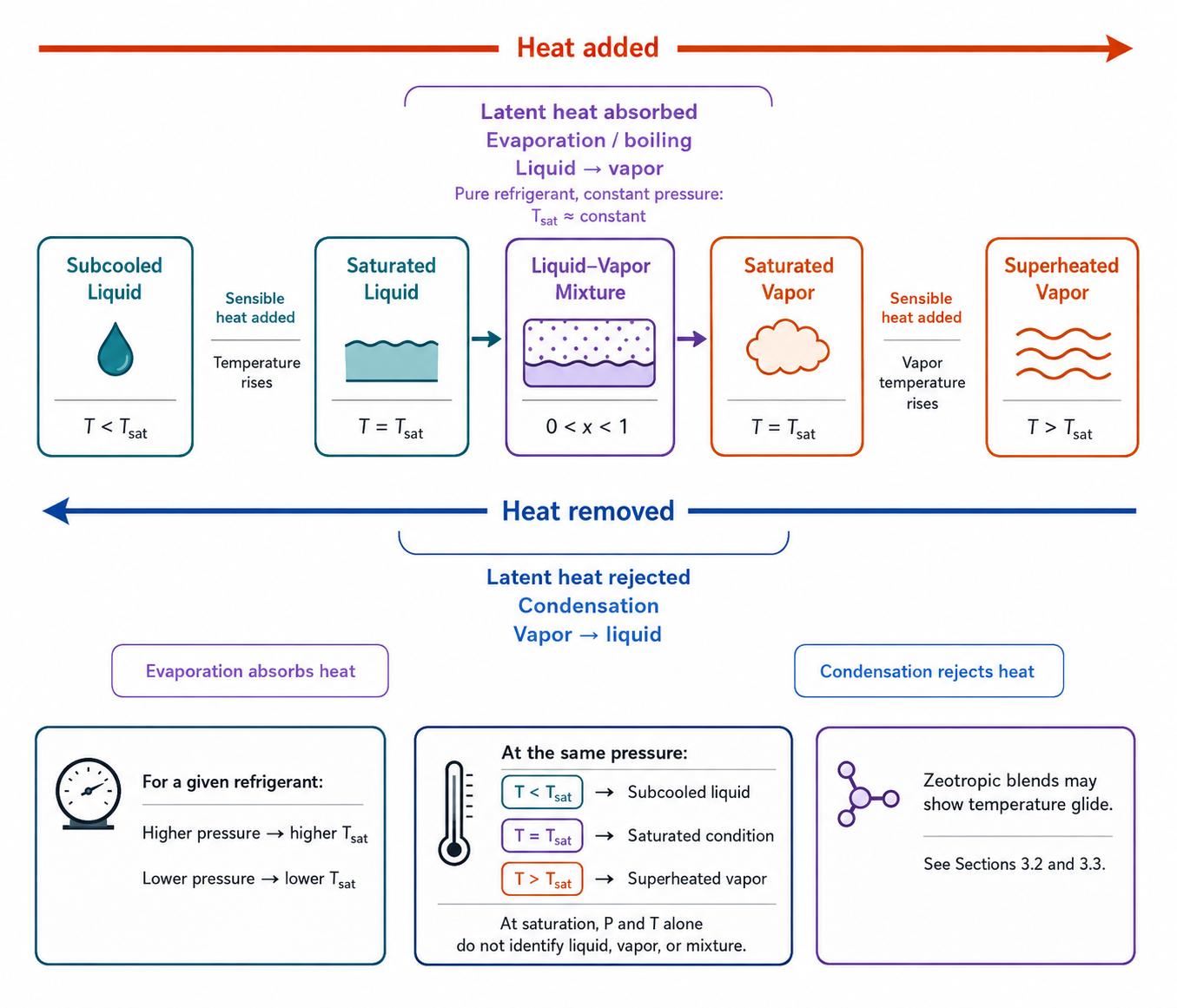
Figure 3.1.1 – Refrigerant liquid-vapor phase change and the relationship among heat transfer, saturation, pressure, and temperature.
AI-generated instructional figure: It may contain visual inaccuracies. Use the accompanying lesson text and cited authoritative sources to verify technical and regulatory details.
EPA 608 Exam Focus
What Students Must Remember
- Refrigerant is used to transfer heat.
- Refrigerant absorbs heat while evaporating.
- Refrigerant rejects heat while condensing.
- Sensible heat changes temperature without changing phase.
- Latent heat is associated with phase change.
- Saturation temperature is the boiling or condensing temperature corresponding to a specified pressure.
- Saturation pressure is the pressure corresponding to a specified saturation temperature.
- For a given refrigerant, higher saturation pressure means higher saturation temperature.
- Lowering pressure lowers saturation temperature.
- A pure refrigerant can boil because its pressure is reduced even when heat is not first added to raise its temperature.
- At a specified pressure:
- Temperature below saturation → subcooled liquid.
- Temperature equal to saturation → saturated condition.
- Vapor temperature above saturation → superheated vapor.
- Pressure and temperature at saturation do not by themselves identify whether the refrigerant is saturated liquid, saturated vapor, or a two-phase mixture.
- Zeotropic blends require bubble-point, dew-point, and temperature-glide concepts, covered in Sections 3.2 and 3.3.
Typical Exam Question Patterns
Students may be asked to:
- Identify which phase change absorbs heat.
- Identify which phase change rejects heat.
- Distinguish sensible from latent heat.
- Define saturation temperature.
- Determine what happens to saturation temperature when pressure increases.
- Explain why refrigerant can boil when pressure is reduced.
- Identify a subcooled-liquid condition.
- Identify a superheated-vapor condition.
- Determine whether pressure or temperature alone is sufficient to identify phase.
- Recognize that blend glide is an exception to an oversimplified constant-temperature phase-change statement.
High-Priority Comparison Table
| Exam Clue | Correct Concept |
|---|---|
| Liquid becomes vapor | Evaporation / vaporization |
| Vapor becomes liquid | Condensation |
| Refrigerant absorbs heat during phase change | Evaporation |
| Refrigerant rejects heat during phase change | Condensation |
| Temperature changes, phase does not | Sensible heat |
| Phase changes | Latent heat |
| Higher pressure for the same refrigerant | Higher saturation temperature |
| Lower pressure for the same refrigerant | Lower saturation temperature |
| Liquid below saturation temperature | Subcooled liquid |
| Vapor above saturation temperature | Superheated vapor |
| Liquid and vapor together | Saturated two-phase mixture |
Common Mistakes and Confusing Points
Mistake 1: Saying the Refrigerant “Creates Cold”
A refrigeration system moves heat. Refrigerant absorbs heat at one location and rejects it at another.
Mistake 2: Saying Evaporation Releases Heat
Evaporation requires energy. In the evaporator, refrigerant absorbs heat as it changes from liquid to vapor.
Mistake 3: Saying Condensation Absorbs Heat
Condensation releases energy from the refrigerant. In the condenser, refrigerant rejects heat while changing from vapor to liquid.
Mistake 4: Assuming Heat Transfer Always Changes Temperature
During a phase change, large amounts of heat can be transferred while the pure refrigerant remains approximately at its saturation temperature when pressure is essentially constant.
Mistake 5: Assuming Boiling Requires a Temperature Increase
Boiling can also be produced by lowering pressure, which lowers saturation temperature.
Mistake 6: Treating Pressure and Temperature as Independent at Saturation
For a pure refrigerant at saturation, pressure and saturation temperature correspond to one another.
Mistake 7: Assuming a Saturated Refrigerant Must Be a 50/50 Liquid-Vapor Mixture
The saturated condition can represent:
- Saturated liquid.
- Saturated vapor.
- Any liquid-vapor mixture between those limits.
“Two phase” does not mean equal masses of liquid and vapor.
Mistake 8: Assuming Temperature Alone Identifies Refrigerant Phase
A temperature is meaningful only when considered with:
- Refrigerant identity.
- Pressure.
- Saturation relationship.
Mistake 9: Assuming Pressure Alone Identifies Refrigerant Phase
At saturation pressure, refrigerant can exist as liquid, vapor, or a mixture. Pressure alone is insufficient.
Mistake 10: Applying the Pure-Refrigerant Constant-Temperature Rule to Every Blend
Zeotropic blends can experience temperature glide during evaporation and condensation. Sections 3.2 and 3.3 develop this distinction.
Concept-Check Questions
Question 1
What is the primary role of a refrigerant in a refrigeration system?
A. To create cold energy inside the evaporator
B. To transfer heat by circulating and undergoing controlled thermodynamic changes
C. To increase the electrical resistance of the compressor motor
D. To prevent all temperature changes in the equipment
Question 2
Which statement correctly describes sensible heat?
A. Heat transfer that changes a substance from liquid to vapor without changing energy
B. Heat released only during condensation
C. Heat transfer that changes temperature without changing phase
D. Heat transfer that can occur only in a refrigerant mixture
Question 3
What happens to refrigerant during evaporation in an evaporator?
A. It absorbs heat as liquid changes toward vapor.
B. It rejects heat as vapor changes to liquid.
C. It remains entirely liquid while pressure always increases.
D. It releases latent heat to the space being cooled.
Question 4
For a given pure refrigerant, what generally happens to saturation temperature when saturation pressure increases?
A. Saturation temperature decreases.
B. Saturation temperature remains fixed for every pressure.
C. Saturation temperature becomes unrelated to pressure.
D. Saturation temperature increases.
Question 5
A pure refrigerant liquid is at a temperature below the saturation temperature corresponding to its measured pressure. What is its condition?
A. Superheated vapor
B. Subcooled liquid
C. Saturated vapor
D. Two-phase mixture
Question 6
A pure refrigerant vapor is at a temperature above the saturation temperature corresponding to its measured pressure. What is its condition?
A. Subcooled liquid
B. Saturated liquid
C. Superheated vapor
D. Liquid-vapor mixture
Question 7
A pure refrigerant is exactly at the saturation pressure and saturation temperature. What can be concluded from pressure and temperature alone?
A. The refrigerant must be all liquid.
B. The refrigerant must be all vapor.
C. The refrigerant must contain equal masses of liquid and vapor.
D. The refrigerant is at saturation, but additional information is needed to determine whether it is saturated liquid, saturated vapor, or a mixture.
Question 8
Which statement correctly qualifies the simplified rule that refrigerant changes phase at constant saturation temperature?
A. It applies most directly to a pure refrigerant at essentially constant pressure; zeotropic blends can exhibit temperature glide.
B. It applies only to refrigerant cylinders and never to operating systems.
C. It means pressure has no effect on boiling temperature.
D. It proves all refrigerants have the same saturation temperature at the same pressure.
Answers and detailed explanations will be provided in
3.10 - Answers and Explanations.md.
Section Summary
Refrigerant is the working fluid that transfers heat through refrigeration and air-conditioning equipment.
The two most important phase changes are:
- Evaporation: liquid → vapor; refrigerant absorbs heat.
- Condensation: vapor → liquid; refrigerant rejects heat.
Sensible heat changes temperature without changing phase. Latent heat is associated with phase change.
For a given pure refrigerant:
- Higher saturation pressure corresponds to higher saturation temperature.
- Lower saturation pressure corresponds to lower saturation temperature.
- Liquid below saturation temperature is subcooled.
- Vapor above saturation temperature is superheated.
- At saturation, liquid and vapor can coexist.
Reducing pressure can cause liquid refrigerant to boil because the saturation temperature falls. This principle allows the evaporator to operate at a low enough temperature to absorb heat from the space or substance being cooled.
The simple pure-refrigerant saturation relationship is the foundation for:
- Pressure-temperature charts.
- Superheat.
- Subcooling.
- Evaporator operation.
- Condenser operation.
Sections 3.2 and 3.3 extend these ideas to refrigerant blends, including azeotropic behavior, zeotropic behavior, bubble point, dew point, and temperature glide.
References
Project and EPA 608 Teaching Sources
-
Current EPA Section 608 teaching-material project outline, Module 3 — Refrigerants Blends and Lubricants, Section 3.1 learning scope and Figure 3.1.1 specification, reviewed August 7, 2026.
-
International Training Institute for the Sheet Metal and Air Conditioning Industry, EPA Section 608 Study Guide, Core refrigeration-cycle discussion and pressure-temperature reference material.
Technical Foundation Sources
-
Edward G. Pita, Air Conditioning Principles and Systems: An Energy Approach, 4th ed., Chapter 2 discussion of boiling, saturation pressure, saturation temperature, saturated liquid, saturated vapor, sensible heat, and latent heat.
-
Justin Kauwale, Mechanical PE: HVAC & Refrigeration Textbook, 2025 ed., thermodynamics and vapor-compression refrigeration discussion of pressure, boiling point, phase change, latent heat, evaporation, and condensation.