8.8 - Type II Evacuation Requirements
Module: Type II High and Very-High-Pressure Appliances
Regulatory verification date: August 12, 2026
Primary current authority: 40 CFR § 82.156 and the current EPA Required Level of Evacuation / Stationary Refrigeration Service Practice Requirements pages
Course role: Teaches the current Section 608 refrigerant-removal levels for Type II appliances and the limited service-practice exceptions that can change the normal Table 1 endpoint
Learning Objectives
After completing this section, a student should be able to:
- Use the current Section 608 evacuation table to select the required refrigerant-removal level for a medium-, high-, or very-high-pressure appliance.
- Explain why the November 15, 1993 date refers to the recovery/recycling equipment manufacture or import date, not the appliance manufacture date.
- Distinguish appliances or isolated components with a full charge less than 200 lb from those with a full charge 200 lb or more where the table requires that distinction.
- State the current Type II evacuation levels for pre-November-15-1993 and on/after-November-15-1993 recovery/recycling equipment.
- Explain what
0 in. Hg vacuummeans and why it is not a perfect vacuum. - Apply the limited non-major service exception for medium-, high-, and very-high-pressure appliances.
- Apply the current exception when a leak makes the normal Table 1 level unattainable or would substantially contaminate the refrigerant being recovered.
- Explain how refrigerant may be isolated in a system receiver so that only the section being opened must be evacuated.
- Recognize the separate current 5 psig oil-change provision.
- Distinguish Section 608 refrigerant-removal requirements from deep-vacuum dehydration targets such as micron-level evacuation.
- Recognize that exact equipment and repair conditions must be classified before selecting an evacuation endpoint.
- Use the current EPA table rather than relying on older simplified study-guide wording.
Introduction
Type II recovery is not complete merely because refrigerant flow becomes slow.
Before a Type II appliance or an isolated part of that appliance is opened for maintenance, service, repair, or disposal, the technician must determine the applicable Section 608 refrigerant-removal endpoint.
The current federal rule uses a table based on three main inputs:
1. Appliance pressure category
2. Appliance or isolated-component full charge
3. Recovery/recycling equipment manufacture or import date
For Type II work, the pressure categories are:
- Medium pressure.
- High pressure.
- Very high pressure.
Where the table distinguishes charge size, the boundary is:
less than 200 lb
versus:
200 lb or more
The date boundary is:
before November 15, 1993
versus:
on or after November 15, 1993
A critical exam point is:
The November 15, 1993 date refers to the recovery/recycling equipment, not to the refrigeration appliance.
Another critical point is that the normal Table 1 level is not always the only legal endpoint. Current § 82.156 includes limited exceptions for:
- Certain non-major maintenance, service, or repair.
- Appliances whose leaks prevent the normal Table 1 level or would substantially contaminate the recovered refrigerant.
- Oil changes.
- Isolation of refrigerant in a system receiver so that only the affected section is opened.
This section develops those rules in a decision-oriented format.
Key Concepts
1. Current Section 608 Table 1 Controls the Normal Case
Source: 40 CFR § 82.156(a), Table 1
For appliances other than small appliances, MVACs, and MVAC-like appliances, technicians must evacuate the refrigerant, including liquid refrigerant, to the applicable Table 1 level before opening or disposing of the appliance unless one of the specific exceptions in § 82.156(a)(1) or (a)(2) applies.
For Type II equipment:
NORMAL CASE
→ use Table 1
Do not replace Table 1 with:
- A generic
0 psigrule. - A generic
500 micronsrule. - A remembered value from a Type I question.
- A leak-repair trigger percentage.
Those are different concepts.
2. The 1993 Date Refers to Recovery Equipment
The current table distinguishes:
Recovery/recycling equipment
manufactured or imported BEFORE Nov. 15, 1993
from:
Recovery/recycling equipment
manufactured or imported ON OR AFTER Nov. 15, 1993
It does not ask:
When was the air conditioner manufactured?
For example:
Appliance manufactured in 1988
+
recovery machine manufactured in 2024
→ use the on/after-Nov. 15, 1993 recovery-equipment column
Likewise:
Appliance manufactured in 2025
+
grandfathered recovery machine manufactured in 1992
→ use the pre-Nov. 15, 1993 recovery-equipment column
if that equipment is legally applicable and otherwise satisfies current requirements.
Exam Trap
The phrase:
equipment manufactured before November 15, 1993
in this context means:
recovery/recycling equipment
not:
the appliance being serviced
3. Current Type II Required Evacuation Levels
Source: 40 CFR § 82.156 Table 1
| Type II Appliance or Isolated Component | Recovery/Recycling Equipment Manufactured or Imported Before Nov. 15, 1993 | Recovery/Recycling Equipment Manufactured or Imported On or After Nov. 15, 1993 |
|---|---|---|
| Very-high-pressure appliance | 0 in. Hg vacuum | 0 in. Hg vacuum |
| High-pressure appliance, full charge < 200 lb | 0 in. Hg vacuum | 0 in. Hg vacuum |
| High-pressure appliance, full charge ≥ 200 lb | 4 in. Hg vacuum | 10 in. Hg vacuum |
| Medium-pressure appliance, full charge < 200 lb | 4 in. Hg vacuum | 10 in. Hg vacuum |
| Medium-pressure appliance, full charge ≥ 200 lb | 4 in. Hg vacuum | 15 in. Hg vacuum |
The regulation also lists the Type III low-pressure requirement as 25 mm Hg absolute, but that row is developed in Module 9.
Post-1993 Type II Memory Table
For the recovery equipment most students will encounter in current service practice:
| Type II Appliance | Required Level |
|---|---|
| Very high pressure | 0 in. Hg vacuum |
| High pressure, < 200 lb | 0 in. Hg vacuum |
| High pressure, ≥ 200 lb | 10 in. Hg vacuum |
| Medium pressure, < 200 lb | 10 in. Hg vacuum |
| Medium pressure, ≥ 200 lb | 15 in. Hg vacuum |
This is a useful exam table, but always first verify that the question is using the on/after-November-15-1993 recovery-equipment column.
4. The 200-lb Boundary Uses Full Charge
Where the current table distinguishes appliance size, use:
full charge < 200 lb
versus:
full charge ≥ 200 lb
The table does not ask how many pounds remain after a leak.
Example:
Normal full charge = 250 lb
Actual refrigerant remaining = 140 lb
The applicable charge classification is still:
250 lb
→ 200 lb or more
The same reasoning applies to an isolated component when the regulatory table refers to the full charge of the appliance or isolated component being evaluated under the applicable condition.
Do not confuse this 200-lb evacuation-table boundary with:
15 lb
→ system-dependent recovery-equipment limitation
or:
50 lb
→ current Section 608 ODS leak-repair applicability threshold
These numbers answer different questions.
Understanding the Vacuum Values
1. Inches of Mercury Vacuum
The Type II rows use:
in. Hg vacuum
relative to a standard atmospheric pressure of:
29.9 in. Hg
On this vacuum scale:
0 in. Hg vacuum
→ approximately atmospheric pressure
A larger vacuum number means a deeper vacuum:
15 in. Hg vacuum
→ deeper than 10 in. Hg vacuum
and:
10 in. Hg vacuum
→ deeper than 4 in. Hg vacuum
2. Zero Inches of Hg Vacuum Is Not Zero Absolute Pressure
This is one of the most important exam traps.
0 in. Hg vacuum
≠
perfect vacuum
Instead:
0 in. Hg vacuum
≈
atmospheric pressure
≈
0 psig under the standard reference
Do not confuse:
0 in. Hg vacuum
with:
0 psia
or:
0 microns absolute
A perfect vacuum is an idealized condition of zero absolute pressure.
3. Section 608 Recovery Endpoint Is Not a Deep-Dehydration Target
A service technician may commonly evacuate a repaired system much deeper during dehydration before charging.
For example, a manufacturer or professional service procedure may specify a micron-level target.
That is a different task.
Section 608 recovery/evacuation table
→ how much refrigerant must be removed before opening/disposal
while:
Deep evacuation / dehydration
→ removes air and moisture after repair
→ prepares system for charging
Therefore:
Do not answer a Section 608 Table 1 question with a generic 500-micron value.
Module 5 developed deep-vacuum and micron-gauge concepts separately.
Table Selection by Pressure Category
1. Very-High-Pressure Appliances
For current Table 1:
Very high pressure
→ 0 in. Hg vacuum
for both:
- Pre-November-15-1993 recovery/recycling equipment.
- On/after-November-15-1993 recovery/recycling equipment.
The 200-lb distinction is not used in the very-high-pressure row.
Representative very-high-pressure refrigerants were introduced in Section 8.2.
2. High-Pressure Appliances Below 200 lb
For a high-pressure appliance or isolated component with full charge:
< 200 lb
the current table requires:
0 in. Hg vacuum
for both equipment-date columns.
Example:
R-410A split system
Full charge = 35 lb
Post-1993 recovery machine
Classification:
High pressure
+
less than 200 lb
+
post-1993 recovery equipment
→ 0 in. Hg vacuum
This does not mean refrigerant may be vented.
The technician still uses certified recovery/recycling equipment and properly removes the refrigerant to the applicable endpoint.
3. High-Pressure Appliances at 200 lb or More
For a high-pressure appliance or isolated component with:
full charge ≥ 200 lb
the required level depends on the recovery/recycling equipment date.
Pre-Nov. 15, 1993 equipment
→ 4 in. Hg vacuum
On/after-Nov. 15, 1993 equipment
→ 10 in. Hg vacuum
This is a high-priority Type II exam distinction.
4. Medium-Pressure Appliances Below 200 lb
For a medium-pressure appliance or isolated component with:
full charge < 200 lb
the current table requires:
Pre-Nov. 15, 1993 equipment
→ 4 in. Hg vacuum
On/after-Nov. 15, 1993 equipment
→ 10 in. Hg vacuum
This is one reason medium-pressure appliances must not be forgotten in Type II preparation.
5. Medium-Pressure Appliances at 200 lb or More
For a medium-pressure appliance or isolated component with:
full charge ≥ 200 lb
the current table requires:
Pre-Nov. 15, 1993 equipment
→ 4 in. Hg vacuum
On/after-Nov. 15, 1993 equipment
→ 15 in. Hg vacuum
For post-1993 recovery equipment, this is the deepest Type II inches-of-Hg-vacuum requirement in Table 1.
Type II Table Decision Process
When an exam question asks for the required evacuation level, use this order.
Step 1 — Identify Appliance Pressure Category
Is the appliance:
- Medium pressure?
- High pressure?
- Very high pressure?
Do not classify from operating gauge pressure.
Use the refrigerant pressure classification from Section 8.2.
Step 2 — Determine Full Charge
Where the row requires it, classify:
< 200 lb
or:
≥ 200 lb
Step 3 — Identify Recovery/Recycle Equipment Date
Determine whether the recovery/recycling machine was manufactured or imported:
before Nov. 15, 1993
or:
on/after Nov. 15, 1993
Step 4 — Check Whether a Service-Practice Exception Applies
Ask:
- Is this a qualifying non-major repair with no evacuation to atmosphere after completion?
- Does a leak make Table 1 unattainable or cause substantial refrigerant contamination?
- Is this an oil change under the special provision?
- Is refrigerant isolated in a system receiver so only a section is being opened?
If no exception applies:
USE TABLE 1
Step 5 — Verify Endpoint Before Opening
The technician must verify that the applicable level has been reached in:
- The appliance, or
- The isolated section that will be opened.
Service-Practice Exceptions
1. Isolating Refrigerant in a System Receiver
Source: 40 CFR § 82.156(a)
The current rule permits the technician to evacuate:
- The entire appliance, or
- Only the part being serviced,
when the refrigerant in that part can be isolated to a system receiver.
This can allow a service procedure such as:
move / isolate refrigerant into system receiver
→ isolate service section
→ evacuate service section to applicable level
→ verify endpoint
→ open service section
The technician must verify that the required level has been reached in the part being opened.
Do not assume that pumping refrigerant into a receiver automatically means the service section is ready to open.
2. Qualifying Non-Major Service Exception
Source: 40 CFR § 82.156(a)(1)
A limited exception applies when both conditions are satisfied:
- After maintenance, service, or repair is complete, evacuation of the appliance to the atmosphere is not to be performed, and
- The maintenance, service, or repair is not major.
For a Type II medium-, high-, or very-high-pressure appliance, the appliance must then be:
evacuated to a pressure no higher than 0 psig
before it is opened
This is a special service-practice rule.
Do not convert it into:
all non-major repairs always require only 0 psig
The full conditions of the exception must be satisfied.
3. What Counts as Major Work?
Source: 40 CFR § 82.152
Major maintenance, service, or repair includes work involving removal of any of these components:
- Compressor.
- Condenser.
- Evaporator.
- Auxiliary heat-exchange coil.
It also includes work involving an opening of more than:
4 in² of flow area
for more than:
15 minutes
This definition matters because the special non-major 0 psig provision does not apply when the work is major.
Section 8.9 develops major-repair and compressor-service scenarios in detail.
4. Leak Prevents Normal Table 1 Evacuation
Source: 40 CFR § 82.156(a)(2)
A leak does not automatically excuse the entire appliance from normal evacuation requirements.
If leaks make the Table 1 level:
- Unattainable, or
- Likely to substantially contaminate the refrigerant being recovered,
the technician must:
Step A — Isolate Where Possible
Isolate leaking components
from non-leaking components
wherever possible
Step B — Non-Leaking Components
Non-leaking components that will be opened or disposed of must be evacuated to:
the normal Table 1 level
Step C — Leaking Components
Leaking components that will be opened or disposed of must be evacuated to:
the lowest level attainable
without substantially contaminating the recovered refrigerant
but that level:
may not exceed 0 psig
High-Priority Memory Aid
LEAK PREVENTS TABLE LEVEL
↓
ISOLATE where possible
↓
NON-LEAKING
→ Table 1
↓
LEAKING
→ lowest attainable
→ not above 0 psig
This current rule is more precise than older simplified study-guide statements that may imply the entire appliance can simply be stopped at atmospheric pressure.
5. Oil-Change Provision
Source: 40 CFR § 82.156(a)(1)(iii)
For an oil change under the applicable service-practice provision, the appliance may be:
evacuated or pressurized
to a pressure no higher than 5 psig
before it is opened
or:
oil may be drained into a system receiver
that is evacuated or pressurized
to no higher than 5 psig
Do not confuse:
5 psig
→ oil-change provision
with:
0 psig
→ qualifying non-major Type II opening rule
or:
0 / 4 / 10 / 15 in. Hg vacuum
→ Table 1 refrigerant-removal values
6. Disposal
Source: 40 CFR § 82.156(a)
For Type II appliances being disposed of, the normal rule is still:
recover refrigerant
→ reach applicable Table 1 level
→ then open / dispose
unless a specific current exception applies.
The phrase:
equipment is being scrapped
does not remove the refrigerant-recovery obligation.
Safe-disposal responsibilities are developed in Section 6.9.
7. Manufacturer Directions Still Matter
Source: 40 CFR § 82.156(g)
Recovery/recycling equipment must be used according to manufacturer directions unless those directions conflict with the federal rule.
Therefore, Table 1 tells the technician:
WHAT endpoint must be achieved
while the recovery-machine manufacturer explains:
HOW to operate that machine
Do not invent one universal valve sequence or hose configuration for every recovery machine.
Technical and Regulatory Details
1. Complete Current Table 1 for Course Reference
The complete current Table 1 is included here so students can see Type II in context.
| Type of Appliance | Recovery/Recycling Equipment Manufactured or Imported Before Nov. 15, 1993 | Recovery/Recycling Equipment Manufactured or Imported On or After Nov. 15, 1993 |
|---|---|---|
| Very-high-pressure appliance | 0 in. Hg vacuum | 0 in. Hg vacuum |
| High-pressure appliance or isolated component, full charge < 200 lb | 0 in. Hg vacuum | 0 in. Hg vacuum |
| High-pressure appliance or isolated component, full charge ≥ 200 lb | 4 in. Hg vacuum | 10 in. Hg vacuum |
| Medium-pressure appliance or isolated component, full charge < 200 lb | 4 in. Hg vacuum | 10 in. Hg vacuum |
| Medium-pressure appliance or isolated component, full charge ≥ 200 lb | 4 in. Hg vacuum | 15 in. Hg vacuum |
| Low-pressure appliance | 25 mm Hg absolute | 25 mm Hg absolute |
Type II rows: very high pressure, high pressure, and medium pressure.
Type III row: low pressure.
2. Why the Equipment-Date Columns Differ
Recovery and recycling equipment manufactured/imported on or after November 15, 1993 is subject to the later EPA equipment-certification framework.
The table therefore requires different endpoint performance for some appliance categories depending on the recovery/recycling equipment date.
For exam purposes, the key point is not the history of the equipment standard.
The key point is:
DATE OF RECOVERY EQUIPMENT
→ selects table column
3. Examples
Example A — High Pressure, 60 lb, Modern Recovery Machine
Given:
Pressure category = high
Full charge = 60 lb
Recovery machine manufactured = 2024
Select:
High pressure
< 200 lb
on/after Nov. 15, 1993
→ 0 in. Hg vacuum
Example B — High Pressure, 300 lb, Modern Recovery Machine
Given:
Pressure category = high
Full charge = 300 lb
Recovery machine manufactured = 2024
Select:
High pressure
≥ 200 lb
on/after Nov. 15, 1993
→ 10 in. Hg vacuum
Example C — Medium Pressure, 120 lb, Modern Recovery Machine
Given:
Pressure category = medium
Full charge = 120 lb
Recovery machine manufactured = 2024
Select:
Medium pressure
< 200 lb
on/after Nov. 15, 1993
→ 10 in. Hg vacuum
Example D — Medium Pressure, 250 lb, Modern Recovery Machine
Given:
Pressure category = medium
Full charge = 250 lb
Recovery machine manufactured = 2024
Select:
Medium pressure
≥ 200 lb
on/after Nov. 15, 1993
→ 15 in. Hg vacuum
Example E — High Pressure, 300 lb, Pre-1993 Recovery Machine
Given:
Pressure category = high
Full charge = 300 lb
Recovery machine manufactured = 1992
Select:
High pressure
≥ 200 lb
pre-Nov. 15, 1993
→ 4 in. Hg vacuum
Example F — Very High Pressure, Any Charge in Table 1
Given:
Pressure category = very high
Current Table 1 gives:
0 in. Hg vacuum
for either recovery-equipment date column.
4. Recovery Endpoint and Pressure Rebound
Section 8.7 explained that appliance pressure can rise after the recovery machine stops because refrigerant can remain:
- Dissolved in oil.
- Trapped as liquid in cold components.
- Isolated behind valves.
- In receiver or piping pockets.
Therefore:
reach required endpoint
→ stop/isolate as directed
→ observe pressure
→ if pressure rebounds above endpoint because refrigerant remains
→ continue recovery
The current federal table defines the endpoint.
It does not establish one universal rebound hold time for every Type II appliance.
5. Isolated Components
The current table repeatedly uses the phrase:
appliance, or isolated component of such appliance
for high- and medium-pressure rows.
This matters in systems with:
- Parallel compressors.
- Multiple evaporators.
- Receivers.
- Branch circuits.
- Large rooftop units with multiple circuits.
If refrigerant can be properly isolated so that only one section is opened, the technician evaluates the applicable requirement for that section under the current rule.
Do not assume:
one gauge at 0 psig
→ every isolated component is empty
Section 8.7 developed this isolation problem in the recovery context.
Important Terms
Evacuation Level
An evacuation level is the pressure endpoint that must be achieved under the applicable Section 608 service-practice condition before an appliance or isolated component is opened or disposed of.
Full Charge
Full charge is the refrigerant quantity required for normal operating characteristics and conditions of the appliance, determined using the applicable regulatory method.
Inches of Mercury Vacuum
Inches of mercury vacuum (in. Hg vacuum) is a gauge-style vacuum measurement referenced to atmospheric pressure. In Table 1, the reference is standard atmospheric pressure of 29.9 in. Hg.
Major Maintenance, Service, or Repair
Major maintenance, service, or repair includes work involving removal of the compressor, condenser, evaporator, or auxiliary heat-exchange coil, or work that uncovers an opening greater than 4 in² of flow area for more than 15 minutes.
Non-Major Repair
A non-major repair is maintenance, service, or repair that does not meet the regulatory definition of major work. Non-major status alone does not automatically create the special 0-psig exception; all conditions of § 82.156(a)(1) must be satisfied.
System Receiver
A system receiver is an isolated portion of the appliance or a specific vessel within the appliance used to hold the refrigerant charge during service or repair.
Vacuum
A vacuum exists when pressure is below the atmospheric reference. A deeper inches-of-Hg vacuum corresponds to a lower absolute pressure.
Figures and Diagrams
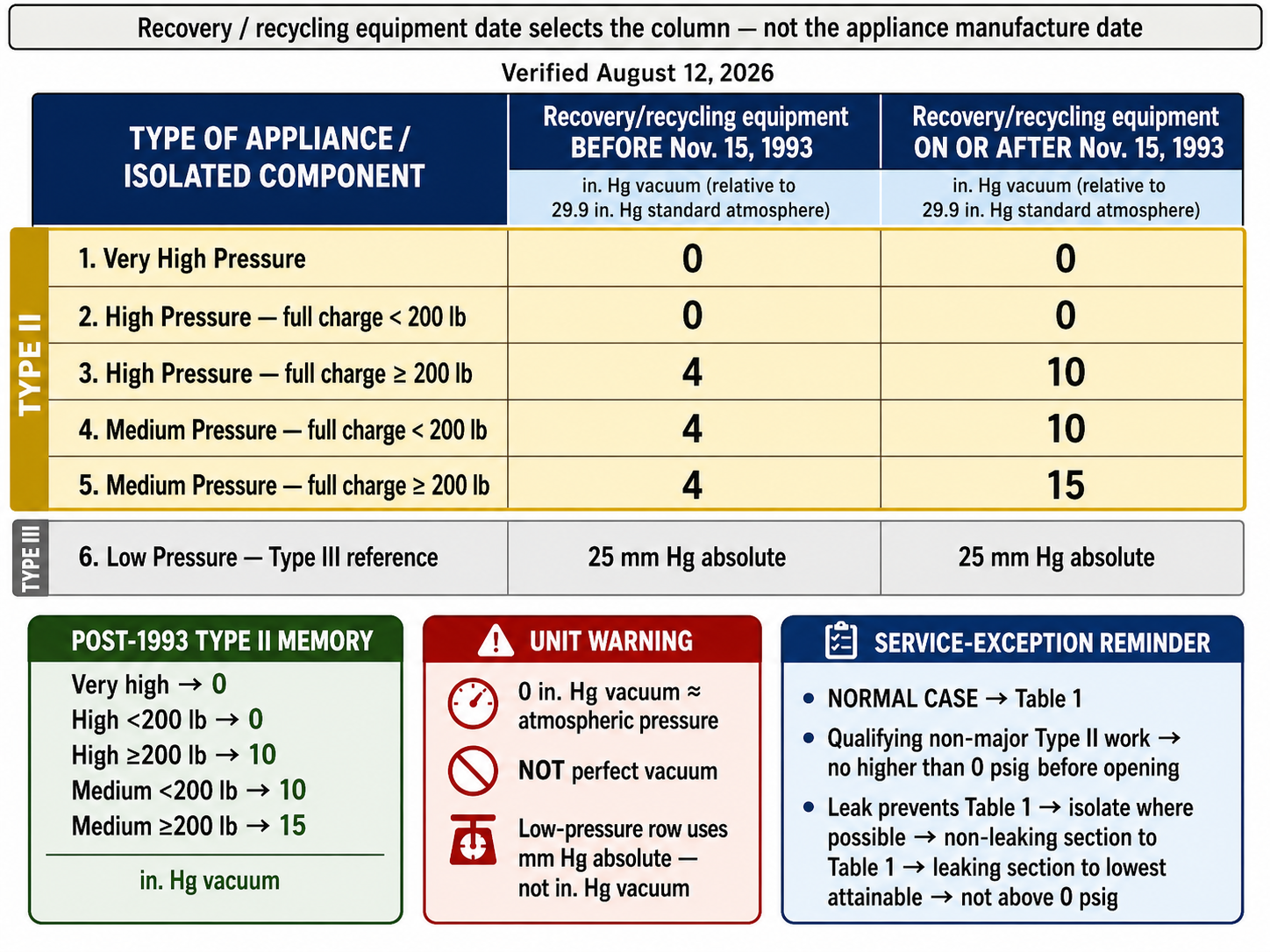
Figure 8.8.1 - Current Section 608 required evacuation levels with the Type II rows emphasized.
AI-generated instructional figure: It may contain visual inaccuracies. Use the accompanying lesson text and cited authoritative sources to verify technical and regulatory details.
EPA 608 Exam Focus
What Students Must Remember
- Table 1 applies to Type II medium-, high-, and very-high-pressure appliances unless a specific current exception applies.
- The November 15, 1993 date refers to the recovery/recycling equipment.
- The date does not refer to appliance manufacture date.
- Where required, use:
- < 200 lb
- ≥ 200 lb
- Very-high-pressure:
- Pre-1993 → 0 in. Hg vacuum
- Post-1993 → 0 in. Hg vacuum
- High-pressure, <200 lb:
- Pre-1993 → 0
- Post-1993 → 0
- High-pressure, ≥200 lb:
- Pre-1993 → 4
- Post-1993 → 10
- Medium-pressure, <200 lb:
- Pre-1993 → 4
- Post-1993 → 10
- Medium-pressure, ≥200 lb:
- Pre-1993 → 4
- Post-1993 → 15
0 in. Hg vacuummeans approximately atmospheric pressure, not perfect vacuum.- Deep evacuation to a micron target is a separate dehydration procedure.
- A limited qualifying non-major Type II repair can use no higher than 0 psig before opening.
- Major work does not receive the non-major shortcut.
- A leak does not automatically excuse the entire appliance from Table 1.
- Isolate leaking and non-leaking portions where possible.
- Non-leaking portions to be opened/disposed must reach Table 1.
- Leaking portions to be opened/disposed go to the lowest attainable level without substantial contamination, not above 0 psig.
- Oil-change work uses the separate no-higher-than-5-psig provision.
- Refrigerant can be isolated in a system receiver so only the affected section is evacuated, when the rule conditions are satisfied.
- The technician must verify the applicable endpoint before opening the appliance or section.
- Exact recovery-machine operation follows manufacturer directions.
Post-1993 Type II Memory Table
| Type II Appliance | Required Level |
|---|---|
| Very high pressure | 0 in. Hg vacuum |
| High pressure, <200 lb | 0 in. Hg vacuum |
| High pressure, ≥200 lb | 10 in. Hg vacuum |
| Medium pressure, <200 lb | 10 in. Hg vacuum |
| Medium pressure, ≥200 lb | 15 in. Hg vacuum |
High-Priority Exception Memory Aid
NORMAL CASE
→ TABLE 1
QUALIFYING NON-MAJOR TYPE II WORK
→ no higher than 0 psig before opening
LEAK PREVENTS TABLE LEVEL
→ isolate leaking / non-leaking where possible
→ non-leaking to Table 1
→ leaking to lowest attainable
→ not above 0 psig
OIL CHANGE
→ no higher than 5 psig
Typical Exam Question Patterns
Students may be asked to:
- Identify which date controls Table 1.
- Select the evacuation level for a high-pressure appliance with less than 200 lb.
- Select the evacuation level for a high-pressure appliance with 200 lb or more.
- Select the evacuation level for a medium-pressure appliance with less than 200 lb.
- Select the evacuation level for a medium-pressure appliance with 200 lb or more.
- Identify the very-high-pressure requirement.
- Distinguish pre-1993 from post-1993 recovery equipment.
- Explain why 0 in. Hg vacuum is not a perfect vacuum.
- Identify the limited non-major 0-psig exception.
- Determine whether compressor removal is major work.
- Apply the leaking-appliance exception.
- Determine what happens to a non-leaking section when another component leaks.
- Identify the 5-psig oil-change provision.
- Distinguish 15 lb, 50 lb, and 200 lb regulatory thresholds.
- Reject 500 microns as the universal Section 608 refrigerant-removal endpoint.
High-Risk Words
Pay particular attention to:
- Recovery equipment
- Appliance
- Before
- On or after
- Less than 200
- 200 or more
- Full charge
- Major
- Non-major
- Isolated
- Leak
- Lowest attainable
- 0 psig
- 5 psig
- Vacuum
- Absolute
Common Mistakes and Confusing Points
Mistake 1: Treating November 15, 1993 as the Appliance Manufacture Date
The table date refers to the recovery/recycling equipment.
Mistake 2: Using > 200 lb Instead of ≥ 200 lb
The current table uses:
less than 200 lb
versus:
200 lb or more
An appliance with exactly 200 lb belongs in the 200 lb or more row.
Mistake 3: Thinking 0 in. Hg Vacuum Means Perfect Vacuum
It means approximately atmospheric pressure on the table’s vacuum scale.
Mistake 4: Answering Every Modern Type II Question With 10 in. Hg Vacuum
Post-1993 Type II values depend on pressure category and charge.
They are:
0 / 0 / 10 / 10 / 15
in the sequence:
VHP
HP <200
HP ≥200
MP <200
MP ≥200
Mistake 5: Applying the 200-lb Threshold to Very-High-Pressure Appliances
The current very-high-pressure Table 1 row is simply:
0 / 0
Mistake 6: Using Remaining Refrigerant Instead of Full Charge
Where the table uses the 200-lb classification, use the applicable full-charge value, not how many pounds happen to remain after a leak.
Mistake 7: Treating Every Non-Major Repair as a 0-psig Job
The current rule requires additional conditions for the non-major exception.
Mistake 8: Treating a Major Repair Like a Non-Major Repair
Removal of the compressor, condenser, evaporator, or auxiliary heat-exchange coil is major work.
Mistake 9: Assuming One Leaking Component Makes the Entire Appliance Exempt
Isolate where possible.
Non-leaking portions still go to Table 1.
Mistake 10: Stopping a Leaking Section Above 0 psig
The leaking section must be evacuated to the lowest attainable level without substantial contamination, and that level may not exceed 0 psig.
Mistake 11: Using a Deep-Dehydration Micron Target as the Table 1 Answer
Micron-level dehydration and Section 608 refrigerant removal are separate procedures.
Mistake 12: Mixing the 15-lb and 200-lb Rules
15 lb
→ system-dependent recovery-equipment limitation
200 lb
→ Type II evacuation-table boundary
Mistake 13: Mixing the 50-lb Leak-Repair Threshold Into Table 1
The current ODS leak-repair applicability threshold is a separate regulatory topic.
Mistake 14: Forgetting the 5-psig Oil-Change Provision
The oil-change provision is neither the normal Table 1 level nor the general non-major 0-psig rule.
Mistake 15: Assuming Pumping Refrigerant Into a Receiver Ends the Evacuation Requirement
The section being opened must still reach the applicable level and be verified.
Concept-Check Questions
Question 8.8-1
A high-pressure appliance has a full charge of 120 lb. The recovery machine was manufactured in 2025. What is the current Table 1 requirement?
A. 0 in. Hg vacuum
B. 4 in. Hg vacuum
C. 10 in. Hg vacuum
D. 15 in. Hg vacuum
Question 8.8-2
A medium-pressure appliance has a full charge of exactly 200 lb. Modern recovery equipment is used. Which current Table 1 row applies?
A. Medium pressure, less than 200 lb → 10 in. Hg vacuum
B. Medium pressure, 200 lb or more → 15 in. Hg vacuum
C. High pressure, 200 lb or more → 10 in. Hg vacuum
D. Very high pressure → 0 in. Hg vacuum
Question 8.8-3
In the current Section 608 evacuation table, what does the November 15, 1993 date classify?
A. The manufacture date of the refrigeration appliance
B. The manufacture/import date of the recovery or recycling equipment
C. The technician certification date
D. The building construction date
Question 8.8-4
What does 0 in. Hg vacuum mean in the current Table 1?
A. Perfect vacuum
B. Zero absolute pressure
C. Approximately atmospheric pressure on the stated vacuum reference
D. 500 microns absolute
Question 8.8-5
A qualifying Type II repair is non-major, and the conditions of § 82.156(a)(1) are satisfied. To what pressure must the medium-, high-, or very-high-pressure appliance be evacuated before opening?
A. No higher than 0 psig
B. Exactly 15 in. Hg vacuum in every case
C. 25 mm Hg absolute
D. No higher than 50 psig
Question 8.8-6
A leak prevents a non-leaking portion of the appliance from reaching the recovery machine unless the system is isolated. What is the correct current approach where isolation is possible?
A. Leave the entire appliance above atmospheric pressure.
B. Isolate leaking from non-leaking portions, evacuate the non-leaking portion to Table 1, and evacuate the leaking portion to the lowest attainable level not above 0 psig.
C. Vent the leaking portion and evacuate only the receiver.
D. Apply the Type I 80% rule.
Question 8.8-7
Which activity is included in the current regulatory definition of major maintenance, service, or repair?
A. Tightening an external cabinet screw
B. Removing the compressor
C. Reading the thermostat
D. Replacing an air filter
Question 8.8-8
Which statement correctly distinguishes the 15-lb and 200-lb values used in Type II work?
A. Both determine the same evacuation-table row.
B. The 15-lb value relates to the system-dependent recovery-equipment limitation; the 200-lb value distinguishes certain Type II Table 1 evacuation rows.
C. The 15-lb value is the current Section 608 ODS leak-repair threshold.
D. The 200-lb value is the maximum recovery-cylinder capacity.
Answers and detailed explanations will be provided in
8.15 - Answers and Explanations.md.
Section Summary
The current Type II evacuation decision is based primarily on:
pressure category
+
full charge where required
+
recovery/recycling equipment date
The key Type II Table 1 values are:
| Type II Appliance | Pre-Nov. 15, 1993 Equipment | On/After-Nov. 15, 1993 Equipment |
|---|---|---|
| Very high pressure | 0 | 0 |
| High pressure, <200 lb | 0 | 0 |
| High pressure, ≥200 lb | 4 | 10 |
| Medium pressure, <200 lb | 4 | 10 |
| Medium pressure, ≥200 lb | 4 | 15 |
All Type II values above are:
in. Hg vacuum
relative to 29.9 in. Hg standard atmosphere
Remember:
0 in. Hg vacuum
≠ perfect vacuum
The normal process is:
classify appliance
→ select Table 1 row
→ reach required endpoint
→ verify endpoint
→ open appliance / isolated section
Limited exceptions include:
QUALIFYING NON-MAJOR TYPE II SERVICE
→ no higher than 0 psig
LEAK PREVENTS TABLE LEVEL
→ isolate where possible
→ non-leaking to Table 1
→ leaking to lowest attainable
→ not above 0 psig
OIL CHANGE
→ no higher than 5 psig
The next section applies these service-practice concepts to major repair, compressor replacement, heat-exchanger replacement, burnout, contaminated oil, and moisture indicators:
Section 8.9 - Major Repair Special Conditions and Compressor Service.
References
Current Regulatory and EPA Sources
-
Electronic Code of Federal Regulations, 40 CFR § 82.156 - Proper Evacuation of Refrigerant From Appliances, verified August 12, 2026.
-
Electronic Code of Federal Regulations, 40 CFR § 82.152 - Definitions, verified August 12, 2026.
-
U.S. Environmental Protection Agency, Required Level of Evacuation of Appliances, verified August 12, 2026.
-
U.S. Environmental Protection Agency, Stationary Refrigeration Service Practice Requirements, verified August 12, 2026.
-
U.S. Environmental Protection Agency, Section 608 Test Topics, verified August 12, 2026.