2.5 - Venting Prohibition
Regulatory verification date: August 6, 2026
Primary authorities: Clean Air Act Section 608, 40 CFR Part 82 Subpart F, and current U.S. Environmental Protection Agency guidance on the prohibition against venting refrigerants
Course role: Explains when refrigerant releases are prohibited, when limited releases are permitted, and how technicians should distinguish intentional venting from de minimis releases, normal-operation emissions, and releases of EPA-exempt substitutes
Learning Objectives
After completing this section, a student should be able to:
- State the Section 608 prohibition against knowingly venting refrigerant during maintenance, service, repair, or disposal.
- Distinguish intentional venting from a de minimis release associated with a good-faith recovery or recycling attempt.
- Explain how hose connection and disconnection can qualify as an allowable incidental release.
- Distinguish emissions during normal equipment operation from releases during maintenance, service, repair, or disposal.
- Identify the importance of EPA’s end-use-specific exemptions for certain substitute refrigerants.
- Explain why nitrogen alone may be released but a nitrogen-and-covered-refrigerant mixture must not be intentionally vented.
- Apply a step-by-step decision process to common service and disposal scenarios.
Introduction
Section 2.4 - Clean Air Act and Montreal Protocol explained that production and import phaseouts do not eliminate the need to manage refrigerants already contained in equipment. Section 608 supports that management by requiring recovery and by prohibiting intentional releases during covered activities.
The central rule is:
A person maintaining, servicing, repairing, or disposing of an appliance or industrial process refrigeration system must not knowingly vent or otherwise knowingly release refrigerant into the environment unless the release falls within a specific permitted category.
EPA currently identifies three broad categories of permitted releases:
- De minimis releases associated with good-faith attempts to recover, recycle, or safely dispose of refrigerant.
- Refrigerant emitted during normal operation rather than during maintenance, service, repair, or disposal.
- Releases of substitute refrigerants that EPA has exempted because their release in specified end uses does not pose a threat to the environment under the Section 608 venting provision.
These categories are limited. They do not authorize a technician to open a charged system and deliberately release refrigerant because recovery is inconvenient, slow, expensive, or technically difficult.
Key Concepts
1. The Venting Prohibition Applies to Covered Activities
The venting prohibition applies when a person is:
- Maintaining equipment.
- Servicing equipment.
- Repairing equipment.
- Disposing of equipment.
- Handling refrigerant as part of those activities.
The current regulation covers:
- Class I refrigerants.
- Class II refrigerants.
- Non-exempt substitute refrigerants.
- Refrigerant blends containing covered components.
Representative covered refrigerants include:
- CFC-11 and CFC-12.
- HCFC-22 and HCFC-123.
- HFC-134a.
- R-410A.
- R-404A.
- R-407C.
- R-32.
- HFO or HFO-containing refrigerants unless EPA has exempted the specific substitute in the specific end use.
The prohibition is not limited to ozone-depleting refrigerants. EPA continues to prohibit knowingly venting non-exempt substitutes, including common HFC refrigerants.
2. “Knowingly” and “Intentional” Do Not Mean “Only When the Technician Wants to Harm the Environment”
The rule does not require proof that the person intended to damage the ozone layer or climate.
A release can be knowing or intentional when a person:
- Opens a valve to discharge refrigerant.
- Cuts a charged refrigerant line without first recovering the refrigerant.
- Removes a component from a charged system and allows the charge to escape.
- Purges a recovery cylinder to the atmosphere.
- Releases refrigerant after it has already been recovered.
- Uses refrigerant to blow debris out of tubing.
- Vents a refrigerant-containing pressure-test mixture.
- Decides not to use available recovery equipment.
The important distinction is whether the person knowingly caused or allowed the release during a covered activity.
3. A Refrigerant Release After Recovery Is Still Prohibited
Recovering refrigerant into a cylinder does not end the venting prohibition.
40 CFR § 82.154 states that knowingly releasing a Class I, Class II, or non-exempt substitute refrigerant after recovery from an appliance violates the venting prohibition.
Examples include:
- Venting a recovery cylinder because it is too full.
- Releasing mixed refrigerant to avoid disposal or reclamation cost.
- Purging a cylinder to change refrigerant type.
- Discharging recovered vapor before transporting the cylinder.
Recovered refrigerant must be:
- Reused where allowed.
- Recycled where allowed.
- Sent for reclamation.
- Sent for proper destruction or disposal through an appropriate facility.
It must not be intentionally released.
De Minimis Releases and Good-Faith Recovery
1. Meaning of De Minimis
De minimis means a limited incidental quantity associated with a good-faith attempt to comply with the recovery, recycling, or safe-disposal requirements.
A release is not de minimis merely because:
- The technician considers the quantity small.
- The appliance contains only a small charge.
- Recovery would take additional time.
- The refrigerant has zero ODP.
- The technician plans to replace the lost refrigerant.
- The refrigerant is inexpensive.
- The release occurs outdoors.
For non-exempt refrigerants, the regulation ties the de minimis determination to compliance with the applicable service practices, use of certified recovery or recycling equipment, technician-certification requirements, and reclamation requirements.
2. Good-Faith Attempt
A good-faith attempt means the technician is actually trying to recover, recycle, or safely dispose of refrigerant using the required practices and suitable equipment.
Evidence of good faith includes:
- Using certified recovery or recycling equipment when refrigerant is removed.
- Using equipment designed for the refrigerant and appliance category.
- Following the recovery-equipment manufacturer’s instructions.
- Recovering to the required level before opening the appliance.
- Using low-loss fittings and appropriate hoses.
- Closing service valves before disconnection.
- Recovering refrigerant trapped in hoses where practical.
- Avoiding unnecessary purging.
- Maintaining recovery equipment and hoses in usable condition.
A deliberate release is not converted into a good-faith release merely because recovery equipment is present at the job site.
3. De Minimis Is Not a Fixed Universal Weight
The Section 608 rule does not establish one universal number of ounces or grams that every technician may release.
The determination depends on:
- The activity.
- The refrigerant.
- The equipment.
- Whether required recovery practices were followed.
- Whether the release was reasonably incidental.
- Whether the technician minimized the release.
- Whether certified recovery equipment was used when required.
Therefore, the correct examination principle is:
De minimis = incidental release during compliant good-faith recovery
It does not mean:
Any small release selected by the technician
Hose Connection and Disconnection
1. Incidental Hose Releases Can Be Permitted
EPA specifically identifies limited releases that occur when connecting or disconnecting hoses to charge or service an appliance as possible de minimis releases.
This allowance recognizes that a small amount of refrigerant may remain in:
- A gauge hose.
- A charging hose.
- A manifold.
- A service fitting.
- A short section between valves.
The release is permitted only as an incidental part of a good-faith, compliant service procedure.
2. The Technician Must Minimize Hose Loss
Good practice includes:
- Use low-loss fittings.
- Use shutoff valves or self-sealing fittings.
- Close the appliance and manifold valves before disconnecting.
- Recover refrigerant from hoses where practical.
- Use the shortest suitable hose length.
- Avoid repeated unnecessary gauge connections.
- Inspect hoses, seals, and fittings.
- Do not use gauge connection as a reason to purge refrigerant intentionally.
3. Gauge Use Still Requires Certification
As explained in Section 1.2 - Who Must Be Certified, attaching or detaching hoses and gauges is generally a technician activity requiring the appropriate Section 608 certification.
The fact that a limited connection loss may be de minimis does not make the activity exempt from certification.
Normal Operation
1. Normal-Operation Emissions Are a Separate Category
EPA identifies refrigerant emitted during normal operation as distinct from refrigerant released during maintenance, service, repair, or disposal.
Examples can include:
- Leakage from seals, joints, or components while equipment operates.
- Mechanical purging associated with certain equipment designs.
- Emissions that occur without a maintenance or disposal action.
These emissions are not automatically treated as a violation of the venting prohibition merely because refrigerant reaches the environment.
2. “Normal Operation” Is Not a General Venting Exception
A person cannot deliberately create a release and then label it normal operation.
Examples that are not protected merely by the equipment being in operation include:
- Opening a service valve to atmosphere.
- Loosening a fitting intentionally to release pressure.
- Cutting a charged line.
- Defeating a control so the system discharges refrigerant.
- Using a purge procedure that is not part of the equipment’s proper operation.
The distinction depends on the nature and cause of the release, not merely on whether the compressor was running.
3. Leak-Repair Requirements Are Separate
The venting prohibition and leak-repair requirements are separate regulatory provisions.
Under the current Section 608 leak-repair provisions:
- The federal leak-repair requirements in 40 CFR § 82.157 apply to appliances containing 50 pounds or more of ozone-depleting refrigerant when the applicable leak-rate threshold is exceeded.
- The 2020 rule removed substitute-refrigerant appliances from the federal Section 608 leak-repair provisions.
- The venting prohibition still applies to non-exempt substitute refrigerants, including HFCs.
Therefore:
A refrigerant can remain covered by the venting prohibition even when the federal Section 608 leak-repair trigger does not apply to that appliance.
Detailed historical and current leak-rate comparisons are reserved for Section 2.8 - Current and Historical Regulation Comparison.
Exempt Substitute Refrigerants
1. Exemption Depends on Both Refrigerant and End Use
EPA has determined that certain substitute refrigerants, when used in specified end uses, do not pose a threat to the environment for purposes of the Section 608 venting prohibition.
An exemption is not automatically valid:
- In every appliance.
- In every retrofit.
- In every charge size.
- Under every code.
- Under every safety standard.
- For every substitute in the same chemical family.
The exact refrigerant and exact end use must match the current regulation.
2. Current Exempt Substitutes in 40 CFR § 82.154(a)(1)
| Exempt Substitute | End Use Covered by the Venting Exemption |
|---|---|
| Carbon dioxide | Any application |
| Nitrogen | Any application |
| Water | Any application |
| Ammonia | Commercial or industrial process refrigeration, or absorption units |
| Chlorine | Industrial process refrigeration involving processing of chlorine and chlorine compounds |
| Hydrocarbons | Industrial process refrigeration involving processing of hydrocarbons |
| Ethane, R-170 | Very-low-temperature refrigeration equipment and non-mechanical heat-transfer equipment |
| Propane, R-290 | Specified end uses including stand-alone retail food refrigeration; household refrigerators and freezers; self-contained room air conditioners for residential and light-commercial air-conditioning and heat pumps; vending machines; self-contained commercial ice machines; very-low-temperature refrigeration; water coolers; and, effective July 15, 2024, refrigerated food processing and dispensing equipment |
| Isobutane, R-600a | Stand-alone retail food refrigerators and freezers; household refrigerators and freezers; and vending machines |
| R-441A | Stand-alone retail food refrigerators and freezers; household refrigerators and freezers; self-contained room air conditioners for residential and light-commercial air-conditioning; heat pumps; and vending machines |
This table summarizes the current federal venting exemptions. The current eCFR text controls when a precise determination is required.
3. An Exemption From the Venting Prohibition Is Not an Exemption From Safety
Even when Section 608 permits release of an exempt substitute, the person must still consider:
- Flammability.
- Toxicity.
- Asphyxiation.
- High pressure.
- Ventilation.
- Fire and building codes.
- Manufacturer instructions.
- Occupational-safety requirements.
- Environmental rules outside Section 608.
- Local restrictions.
Examples:
- R-290 and R-600a are flammable.
- Ammonia is toxic and has limited flammability.
- Carbon dioxide can create high-pressure and asphyxiation hazards.
- Nitrogen can displace oxygen.
“Exempt from the Section 608 venting prohibition” does not mean “safe to release in an occupied space.”
4. Non-Exempt Substitutes Remain Covered
Common non-exempt substitutes include many HFC and HFO refrigerants.
Examples include:
- R-134a.
- R-410A.
- R-404A.
- R-407C.
- R-32.
- HFO-1234yf in stationary uses unless a specific exemption applies.
- HFO/HFC blends unless the specific substitute and end use are exempted.
The correct method is to check the current regulation rather than assume that low GWP or zero ODP creates an exemption.
Pressure Testing With Nitrogen
1. Nitrogen Alone Is an Exempt Substitute
Nitrogen is listed as exempt from the Section 608 venting prohibition in any application.
Dry nitrogen is commonly used for:
- Pressure testing.
- Leak checking.
- Breaking a vacuum.
- Sweeping or purging tubing during brazing.
- Pressurizing an isolated system after refrigerant recovery.
The nitrogen must be used with suitable pressure regulation and safe work practices.
2. Recover Refrigerant Before Nitrogen Pressure Testing
Before opening or pressure testing a charged system:
- Recover the refrigerant using the applicable required procedure.
- Isolate components where appropriate.
- Confirm that the recovery process is complete to the required level.
- Introduce regulated, dry nitrogen for the test.
- Perform leak testing according to the equipment and manufacturer procedure.
- Release nitrogen only when the discharged gas is not carrying a covered refrigerant.
- Evacuate and recharge the system according to the applicable service procedure.
The project does not prescribe one universal nitrogen test pressure. The proper pressure depends on:
- Equipment design pressure.
- Manufacturer instructions.
- Component ratings.
- Applicable code.
- Refrigerant system type.
- The specific test objective.
3. A Nitrogen-and-Refrigerant Mixture Must Not Be Intentionally Vented
Nitrogen’s exemption does not exempt the covered refrigerant mixed with it.
If nitrogen is added to a system that still contains Class I, Class II, or non-exempt substitute refrigerant, the resulting gas mixture contains covered refrigerant.
Therefore:
The refrigerant-containing mixture must be recovered rather than intentionally released.
This principle applies when nitrogen is used to:
- Raise pressure for leak testing.
- Break a vacuum while refrigerant remains.
- Pressurize a receiver or component.
- Move refrigerant through a system.
- Purge a charged system.
A technician must not dilute refrigerant with nitrogen and then treat the entire mixture as exempt.
4. Do Not Use Oxygen or Compressed Air as a Substitute for Nitrogen
Oxygen or compressed air can create:
- Fire or explosion hazards.
- Dangerous reactions with oil and refrigerant.
- Moisture contamination.
- Excessive pressure.
- Equipment damage.
Use dry nitrogen with an appropriate regulator when nitrogen pressure testing is permitted by the equipment manufacturer and applicable procedures.
Detailed pressure-testing safety is developed later in Module 4.
Servicing and Disposal Scenarios
Scenario 1: Recovering R-410A Before Replacing a Compressor
A technician connects certified recovery equipment, recovers R-410A, and then disconnects the hoses. A small unavoidable quantity escapes from the hose fitting.
Interpretation: The release can be de minimis when it is incidental to a good-faith recovery attempt and the applicable practices are followed.
Scenario 2: Cutting a Charged R-22 Line
A technician cuts a line because the recovery machine is not available.
Interpretation: Prohibited intentional release. Convenience does not create a de minimis exception.
Scenario 3: Purging a Recovery Cylinder
A technician releases recovered R-134a from a cylinder to make room for another refrigerant.
Interpretation: Prohibited. Knowing release after recovery is specifically covered.
Scenario 4: Refrigerant Leaking During Normal Operation
A seal slowly leaks while an appliance operates and no service action is occurring.
Interpretation: This is treated separately from service venting. Other leak-repair, safety, environmental, warranty, or maintenance obligations may still apply.
Scenario 5: Releasing Nitrogen After a Leak Test
The refrigerant was properly recovered, the system was pressure tested with dry nitrogen, and testing indicates that the discharge contains nitrogen rather than a refrigerant mixture.
Interpretation: Nitrogen is exempt under Section 608. Safe ventilation and pressure-control procedures still apply.
Scenario 6: Releasing a Nitrogen-and-R-410A Mixture
A technician adds nitrogen to a system that still contains R-410A and vents the mixture after testing.
Interpretation: Prohibited. R-410A remains a non-exempt refrigerant even when mixed with nitrogen.
Scenario 7: Releasing R-290 From a Listed Exempt End Use
A qualifying R-290 appliance falls within an end use listed in 40 CFR § 82.154(a)(1).
Interpretation: The refrigerant is exempt from the federal Section 608 venting prohibition for that specific end use. Flammability, ventilation, code, disposal, and manufacturer requirements still control safe handling.
Scenario 8: Releasing R-290 From an Unlisted End Use
A technician assumes all propane refrigerant is exempt in every application.
Interpretation: Incorrect. Hydrocarbon exemptions are end-use specific unless the regulation expressly states otherwise.
Technical and Regulatory Details
1. Three Permitted Release Categories
| Category | Regulatory Meaning | Example |
|---|---|---|
| De minimis release | Incidental release during a compliant good-faith recovery, recycling, or safe-disposal attempt | Small connection loss from a service hose |
| Normal-operation emission | Emission occurring during operation rather than during maintenance, service, repair, or disposal | Ordinary equipment leak or mechanical purge |
| EPA-exempt substitute | Substitute listed as exempt in the specified end use | Carbon dioxide in any application |
Every other knowing release during maintenance, service, repair, or disposal should be treated as prohibited unless a current rule clearly provides otherwise.
2. Venting and Evacuation Are Related but Different
The venting prohibition states that covered refrigerant must not be knowingly released.
The evacuation requirements specify the level to which refrigerant must be recovered before an appliance is opened or disposed of.
A technician can violate:
- The venting prohibition by deliberately releasing refrigerant.
- The evacuation requirement by failing to recover to the required level.
- Both requirements through the same improper service action.
The specific evacuation levels are developed in later equipment-type modules.
3. Venting and Leak Repair Are Related but Different
| Venting Prohibition | Leak-Repair Requirement |
|---|---|
| Focuses on knowing releases during covered activities | Focuses on correcting excessive operational leakage from specified appliances |
| Applies broadly to ODS and non-exempt substitutes | Current federal Section 608 leak-repair rule applies to qualifying appliances containing ODS refrigerant |
| Does not require a 50-pound minimum charge | Applies when the appliance has a full charge of 50 pounds or more |
| Has de minimis and exempt-substitute concepts | Uses annualized leak rates and repair procedures |
4. Environmental Properties Do Not Determine the Entire Rule
A refrigerant’s ODP or GWP does not by itself determine whether venting is lawful.
Examples:
- R-410A has zero ODP but is a non-exempt substitute and must not be intentionally vented.
- R-744 has GWP 1 but is exempt from the Section 608 venting prohibition in any application.
- R-290 has low GWP but is exempt only in specified end uses.
- Ammonia has low direct climate effect but is exempt only in listed refrigeration and absorption applications.
Important Terms
De Minimis Release
A de minimis release is a limited incidental release associated with a good-faith attempt to recover, recycle, or safely dispose of refrigerant while complying with the applicable practices.
Exempt Substitute
An exempt substitute is a substitute refrigerant that EPA has exempted from the Section 608 venting prohibition in the end use specified by the regulation.
Good-Faith Attempt
A good-faith attempt is an actual effort to comply with recovery, recycling, disposal, equipment, certification, and service-practice requirements while minimizing emissions.
Intentional Venting
Intentional venting is knowingly releasing covered refrigerant to the environment rather than recovering or otherwise managing it through a permitted pathway.
Low-Loss Fitting
A low-loss fitting minimizes refrigerant release during connection and disconnection of service hoses.
Non-Exempt Substitute
A non-exempt substitute is a refrigerant substitute that has not been exempted by EPA for the applicable end use and therefore remains subject to the venting prohibition.
Normal Operation
Normal operation is ordinary functioning of equipment rather than maintenance, service, repair, or disposal. Emissions during normal operation are treated separately from knowing service venting.
Recover
To recover means to remove refrigerant from an appliance and store it in an external container without necessarily testing or processing it.
Vent
To vent means to release refrigerant or another gas to the surrounding environment.
Figures and Diagrams
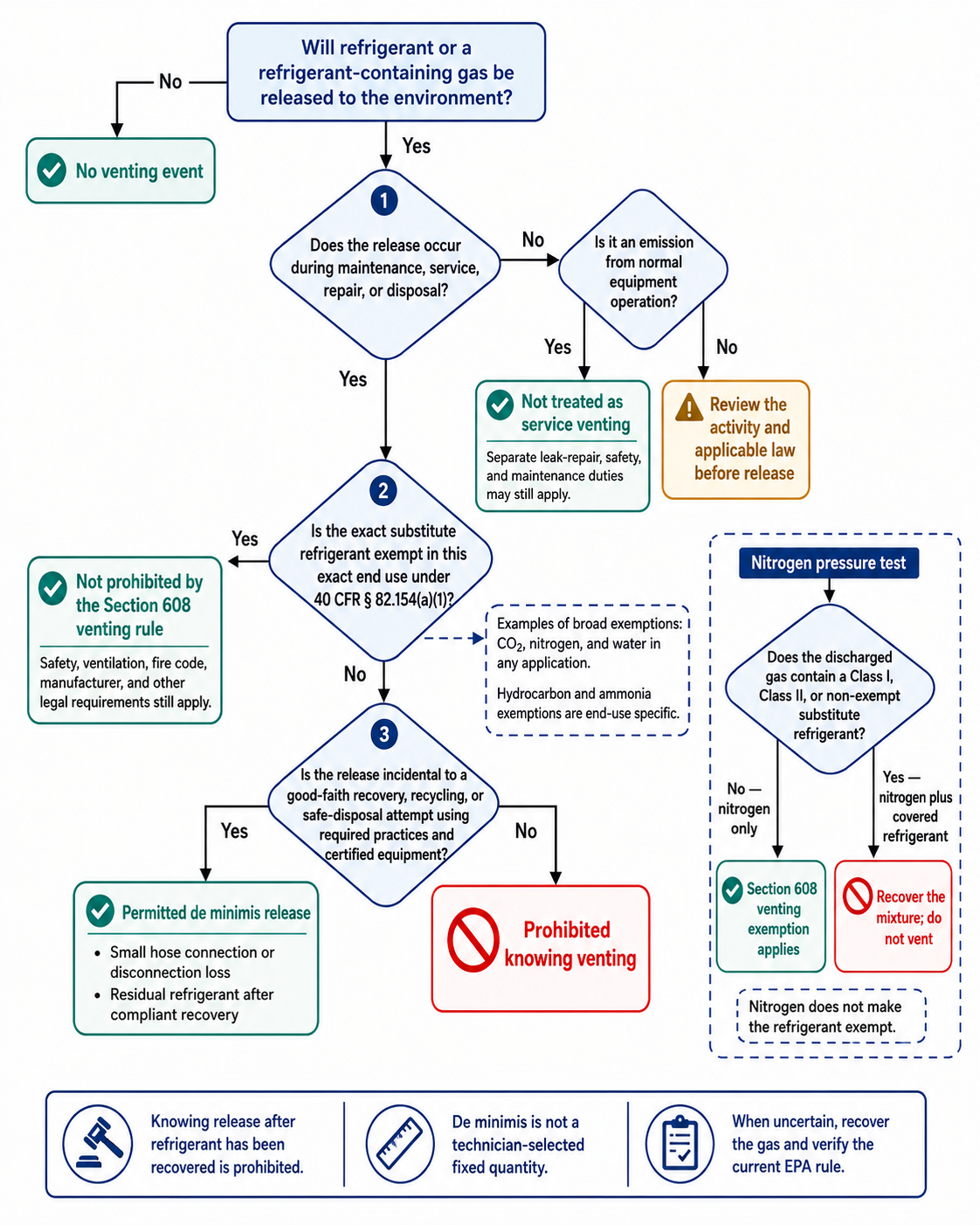
Figure 2.5.1 – Decision process for distinguishing prohibited venting from permitted refrigerant releases.
AI-generated instructional figure: It may contain visual inaccuracies. Use the accompanying lesson text and cited authoritative sources to verify technical and regulatory details.
EPA 608 Exam Focus
What Students Must Remember
- Knowingly venting refrigerant during maintenance, service, repair, or disposal is prohibited.
- The prohibition applies to ODS refrigerants and non-exempt substitutes.
- HFC refrigerants such as R-410A and R-134a must not be intentionally vented.
- Only three broad release categories are permitted:
- De minimis releases during good-faith recovery or recycling.
- Emissions during normal operation.
- Releases of EPA-exempt substitutes in listed end uses.
- De minimis does not mean any quantity the technician considers small.
- Small hose connection and disconnection losses can be de minimis when the applicable practices are followed.
- A knowing release after recovery is prohibited.
- A normal-operation leak is not the same as service venting.
- Federal leak-repair requirements and the venting prohibition are separate.
- Carbon dioxide, nitrogen, and water are exempt in any application under the current Section 608 rule.
- Ammonia and hydrocarbon exemptions depend on the end use.
- Nitrogen alone may be released under the Section 608 exemption.
- A nitrogen-and-covered-refrigerant mixture must be recovered.
- Low ODP or low GWP does not automatically create a venting exemption.
- Safety and code requirements still apply to exempt substitutes.
Typical Exam Question Patterns
Students may be asked to:
- Identify an example of prohibited intentional venting.
- Identify a de minimis release.
- Explain why hose disconnection can produce an allowable incidental release.
- Distinguish normal-operation leakage from service venting.
- Identify a refrigerant broadly exempt from the venting prohibition.
- Determine whether an R-290 exemption applies in a particular end use.
- Explain why R-410A cannot be intentionally vented.
- Determine what to do with a nitrogen-and-refrigerant pressure-test mixture.
- Explain whether refrigerant can be vented after it has been recovered.
- Distinguish venting requirements from leak-repair requirements.
High-Priority Decision Summary
| Exam Clue | Best Association |
|---|---|
| Deliberately opening a charged system to atmosphere | Prohibited venting |
| Small hose loss during compliant recovery | Potential de minimis release |
| Release after recovery | Prohibited |
| Ordinary operational leak | Normal-operation category; other duties may apply |
| Carbon dioxide in any application | Exempt substitute |
| Nitrogen in any application | Exempt substitute |
| R-410A | Non-exempt substitute; do not vent |
| Nitrogen plus R-410A | Recover mixture; do not vent |
| R-290 | Check exact end-use exemption |
| Low GWP | Does not by itself establish exemption |
Common Mistakes and Confusing Points
Mistake 1: Assuming Only CFCs and HCFCs Are Covered
The prohibition also applies to non-exempt substitutes such as common HFC refrigerants.
Mistake 2: Treating Every Small Release as De Minimis
The release must be incidental to a good-faith, compliant recovery or recycling effort.
Mistake 3: Treating Hose Release as Automatically Legal
Hose losses must be minimized and associated with proper charging or service practices.
Mistake 4: Treating Normal Operation as Permission to Create a Leak
Ordinary operational emissions are a separate category. Deliberately opening the circuit is not normal operation.
Mistake 5: Assuming Zero ODP Means Venting Is Allowed
R-410A and R-134a have zero ODP but remain subject to the venting prohibition.
Mistake 6: Assuming Every Hydrocarbon Is Exempt in Every Application
Hydrocarbon exemptions are end-use specific.
Mistake 7: Assuming an Exempt Substitute Is Safe to Release Indoors
Section 608 exemption does not remove fire, toxicity, asphyxiation, ventilation, or code hazards.
Mistake 8: Assuming Nitrogen Makes a Refrigerant Mixture Exempt
Nitrogen is exempt, but the covered refrigerant in the mixture is not.
Mistake 9: Venting Recovered Refrigerant
The prohibition continues after refrigerant has been transferred into a recovery cylinder.
Mistake 10: Confusing Leak-Repair Rules With Venting Rules
The 50-pound charge threshold belongs to the leak-repair rule, not to the general venting prohibition.
Concept-Check Questions
Question 1
Which action most clearly violates the Section 608 venting prohibition?
A. Disconnecting a low-loss hose after a compliant recovery procedure and releasing a small residual quantity
B. Recovering refrigerant into a certified recovery cylinder
C. Cutting a charged R-22 line without first recovering the refrigerant
D. Releasing nitrogen from a system after refrigerant has been properly recovered
Question 2
Which statement best describes a de minimis refrigerant release?
A. Any release below one pound
B. A limited incidental release associated with a good-faith recovery or recycling attempt that follows the applicable practices
C. Any release from equipment containing less than 50 pounds
D. Any release of a zero-ODP refrigerant
Question 3
Why can a small release during hose disconnection be permitted?
A. Gauge hoses are not part of refrigeration service.
B. All hose releases are exempt regardless of the procedure.
C. The release can be incidental to a good-faith, compliant charging or recovery procedure.
D. Refrigerant trapped in a hose is no longer regulated.
Question 4
Which statement about normal-operation emissions is most accurate?
A. They are treated separately from releases during maintenance, service, repair, or disposal, but other leak-repair or maintenance duties may apply.
B. Every operational leak is automatically a knowing venting violation.
C. A technician may open a valve to atmosphere whenever the compressor is operating.
D. Normal-operation emissions are permitted only for CFC refrigerants.
Question 5
Which refrigerant is exempt from the Section 608 venting prohibition in any application under the current regulation?
A. R-410A
B. R-404A
C. R-134a
D. Carbon dioxide
Question 6
Which statement about R-290 is correct?
A. It may be vented in every application because it is a hydrocarbon.
B. Its venting exemption applies only in the end uses specified by the current regulation.
C. It is never exempt from the venting prohibition.
D. It is exempt only when mixed with R-410A.
Question 7
A technician pressure-tests a system with nitrogen while R-410A remains in the circuit. What must be done with the discharged gas?
A. Vent it because nitrogen is exempt.
B. Recover the mixture because it contains a non-exempt refrigerant.
C. Add more nitrogen until the R-410A concentration is negligible.
D. Vent it only if the equipment contains less than 50 pounds.
Question 8
Which statement about recovered refrigerant is correct?
A. It may be released after recovery because it is no longer inside an appliance.
B. It may be vented if the cylinder contains mixed refrigerants.
C. Knowingly releasing a covered refrigerant after recovery violates the venting prohibition.
D. Only recovered CFC refrigerant remains subject to the prohibition.
Answers and detailed explanations will be provided in
2.11 - Answers and Explanations.md.
Section Summary
Section 608 prohibits knowingly venting refrigerant during maintenance, service, repair, or disposal of refrigeration and air-conditioning equipment.
EPA identifies three broad categories of permitted releases:
- De minimis releases associated with good-faith recovery, recycling, or safe disposal.
- Refrigerant emitted during normal equipment operation.
- Releases of substitutes specifically exempted by EPA in specified end uses.
A de minimis release is not a fixed technician-selected amount. It must be incidental to compliant service using the required practices and suitable equipment.
Small hose connection and disconnection losses can qualify as de minimis, but the technician must minimize the release.
The venting prohibition applies to ozone-depleting refrigerants and non-exempt substitutes, including common HFCs. Knowing release remains prohibited after refrigerant has been recovered.
Nitrogen is exempt in any application. However, nitrogen does not make a covered refrigerant exempt. A nitrogen-and-refrigerant mixture must be recovered rather than intentionally vented.
Exempt substitutes must still be handled according to safety, code, manufacturer, and other legal requirements.
References
Current EPA and Regulatory Sources
-
U.S. Environmental Protection Agency, Stationary Refrigeration — Prohibition on Venting Refrigerants, accessed August 6, 2026.
-
U.S. Environmental Protection Agency, Stationary Refrigeration and Air Conditioning, accessed August 6, 2026.
-
U.S. Environmental Protection Agency, Stationary Refrigeration Service Practice Requirements, accessed August 6, 2026.
-
U.S. Environmental Protection Agency, Regulatory Updates: Section 608 Refrigerant Management Regulations, accessed August 6, 2026.
-
U.S. Environmental Protection Agency, Section 608 Technician Certification Requirements, accessed August 6, 2026.
-
U.S. Environmental Protection Agency, Stationary Refrigeration Leak Repair Requirements, accessed August 6, 2026.
-
U.S. Environmental Protection Agency, Section 608 Test Topics, accessed August 6, 2026.
-
Electronic Code of Federal Regulations, 40 CFR § 82.154 — Prohibitions, current through August 4, 2026 and accessed August 6, 2026.
-
Electronic Code of Federal Regulations, 40 CFR Part 82, Subpart F — Recycling and Emissions Reduction, accessed August 6, 2026.
-
U.S. Environmental Protection Agency, Ensuring Leak-Tight Installations of Commercial Refrigeration Equipment, pressure-testing guidance, accessed August 6, 2026.