2.2 - Ozone Depletion Process
Scientific verification date: August 6, 2026
Primary authorities: Current U.S. Environmental Protection Agency ozone-layer science resources and the 2022 Scientific Assessment of Ozone Depletion
Course role: Explains how long-lived chlorine- and bromine-containing compounds reach the stratosphere, release reactive halogen atoms, and participate repeatedly in ozone-destruction reactions
Learning Objectives
After completing this section, a student should be able to:
- Explain why many chlorofluorocarbons and related ozone-depleting substances can survive long enough to reach the stratosphere.
- Describe how intense ultraviolet radiation breaks down ozone-depleting substances and releases reactive chlorine or bromine.
- Write and interpret a simplified chlorine-catalyzed ozone-destruction cycle.
- Explain why chlorine and bromine are described as catalysts in ozone-depletion chemistry.
- Compare the ozone-depletion behavior of CFCs, HCFCs, and major bromine-containing ozone-depleting substances.
- Explain how atmospheric conditions can convert stored halogen compounds into highly reactive forms that accelerate ozone loss.
Introduction
Section 2.1 - The Ozone Layer explained that stratospheric ozone absorbs harmful ultraviolet radiation and that depletion of the ozone layer allows more UVB to reach the Earth’s surface. The next question is how chemicals released near the ground can reduce ozone many kilometers above the surface.
Many historically important ozone-depleting substances are unusually stable in the troposphere. They are not rapidly removed by rain or ordinary lower-atmosphere reactions. Atmospheric circulation and mixing can therefore transport them into the stratosphere. There, more energetic ultraviolet radiation can break their chemical bonds and release reactive chlorine or bromine.
The released halogen atom does not normally destroy only one ozone molecule and then disappear. It can be regenerated through a sequence of reactions and repeat the process many times. This repeated reaction sequence is called a catalytic cycle.
Understanding this process provides the scientific basis for controlling releases of CFCs, HCFCs, halons, and other ozone-depleting substances during refrigeration and air-conditioning service and disposal.
Key Concepts
1. Ozone-Depleting Substances Begin Near the Earth’s Surface
Ozone-depleting substances, abbreviated ODSs, have been used in products and processes such as:
- Refrigerants.
- Foam-blowing agents.
- Fire-suppression agents.
- Solvents and cleaning agents.
- Aerosol propellants.
- Chemical feedstocks and process applications.
Historically important chlorine-containing ODSs include:
- Chlorofluorocarbons (CFCs).
- Hydrochlorofluorocarbons (HCFCs).
- Carbon tetrachloride.
- Methyl chloroform.
Important bromine-containing ODSs include:
- Halons.
- Methyl bromide.
- Other controlled brominated compounds.
These substances may be emitted during:
- Equipment leakage.
- Servicing.
- Charging or refrigerant transfer.
- Improper disposal.
- Intentional venting.
- Product manufacture or use.
- Fire-suppression discharge.
- Failure to recover refrigerant.
The environmental sequence begins with emission, but the ozone loss occurs mainly after the chlorine- or bromine-containing substance reaches the stratosphere.
2. Atmospheric Stability Allows Long-Distance Transport
Many CFC molecules are highly stable in the troposphere because:
- They contain strong carbon-halogen bonds.
- They react only slowly with common lower-atmosphere chemicals.
- They are not readily dissolved and removed by precipitation.
- They can remain in the atmosphere for many years.
Because of this stability, CFCs become widely mixed in the atmosphere. Atmospheric circulation gradually transports a portion of them into the stratosphere. EPA explains that movement from the surface to the stratosphere can take approximately two to five years.
The molecules do not reach the stratosphere simply because they are lighter than air. Atmospheric mixing and large-scale circulation transport gases regardless of this simplified density explanation.
3. HCFCs Are Less Stable Than CFCs but Still Deplete Ozone
HCFC molecules contain hydrogen, while CFC molecules contain chlorine, fluorine, and carbon but no hydrogen.
The presence of hydrogen generally makes an HCFC more susceptible to reaction in the troposphere. A greater fraction can therefore be destroyed before reaching the stratosphere.
This is why HCFCs generally have lower ozone-depletion potentials than comparable CFCs. However:
- Some HCFC molecules still survive transport to the stratosphere.
- They still contain chlorine.
- Ultraviolet decomposition can still release reactive chlorine.
- Their ozone-depletion potential is lower than that of many CFCs but is not zero.
The complete comparison among CFCs, HCFCs, HFCs, HFOs, and alternative refrigerants is developed in Section 2.3 - Refrigerant Families ODP and GWP.
4. Strong Ultraviolet Radiation Breaks Down ODS Molecules
The lower atmosphere shields many ODS molecules from the most energetic ultraviolet radiation. After an ODS reaches the stratosphere, stronger UV radiation can break a carbon-chlorine or carbon-bromine bond.
This process is called photodissociation or photolysis.
A simplified example using CFC-12 is:
The dot indicates an unpaired electron. The chlorine species is therefore a highly reactive free radical.
The equation is a simplified representation. Real stratospheric chemistry includes many intermediate reactions, transport processes, and temporary storage compounds. The examination-level concept is:
Long-lived ODS reaches the stratosphere
→ strong ultraviolet radiation breaks the molecule
→ reactive chlorine or bromine becomes available
→ catalytic ozone destruction can occur
5. Chlorine Reacts With Ozone
A reactive chlorine atom can remove one oxygen atom from an ozone molecule:
In this reaction:
- Ozone, , is converted to ordinary molecular oxygen, .
- The chlorine atom becomes chlorine monoxide, .
- The chlorine has not left the reaction system; it is temporarily part of another reactive species.
If this were the only reaction, one chlorine atom would destroy only one ozone molecule. The next reaction is what makes the process catalytic.
6. The Chlorine Atom Is Regenerated
Chlorine monoxide can react with an oxygen atom:
The second reaction:
- Produces another oxygen molecule.
- Releases the chlorine atom again.
- Allows the chlorine atom to react with another ozone molecule.
Adding the two reactions and canceling the chlorine-containing intermediates gives the simplified net reaction:
The chlorine atom does not appear in the net equation because it is consumed in one step and regenerated in another.
This is the meaning of catalytic in the simplified cycle:
The reactive chlorine participates in the reactions but is regenerated at the end of the cycle, allowing it to repeat the ozone-destruction sequence.
EPA commonly explains that one chlorine atom can destroy more than 100,000 ozone molecules before it is removed from the stratosphere. This is an approximate scientific illustration of catalytic repetition, not a regulatory threshold or a fixed count for every atmospheric condition.
7. Atomic Oxygen Participates in the Simplified Cycle
The symbol in the second reaction represents an individual oxygen atom rather than an molecule.
Atomic oxygen is produced naturally by ultraviolet-driven reactions involving oxygen and ozone. As introduced in Section 2.1:
and:
The simplified chlorine cycle therefore interacts with the natural ozone-oxygen chemistry of the stratosphere.
Different catalytic cycles dominate under different altitudes, temperatures, sunlight conditions, and chemical environments. The two-step cycle presented here is the standard conceptual model used to explain why chlorine can be regenerated.
8. Bromine Also Participates in Catalytic Ozone Destruction
Bromine-containing ODSs can release reactive bromine in the stratosphere.
A simplified bromine cycle can be represented as:
and:
The bromine atom is regenerated in a manner similar to chlorine.
Bromine is much less abundant in the stratosphere than chlorine, but the 2022 Scientific Assessment reports that bromine is approximately 60 to 65 times more efficient per atom than chlorine as an ozone-destroying catalyst. Bromine therefore has an important effect despite its lower atmospheric abundance.
In polar ozone loss, coupled reactions involving chlorine monoxide and bromine monoxide can also be important. The EPA 608 examination concept is that both chlorine and bromine can participate repeatedly in ozone destruction.
9. Reactive Halogens Can Be Stored Temporarily
Not every chlorine or bromine atom remains continuously active.
Reactive chlorine can be converted into more stable reservoir species, including:
- Hydrogen chloride, .
- Chlorine nitrate, .
Reactive bromine can also form reservoir compounds.
Reservoir species temporarily reduce the amount of chlorine or bromine available for rapid ozone destruction. However, atmospheric reactions can later convert reservoir species back into reactive forms.
This helps explain why ozone loss varies with:
- Altitude.
- Latitude.
- Season.
- Temperature.
- Sunlight.
- Atmospheric circulation.
- Aerosol and cloud-particle surfaces.
10. Polar Conditions Can Accelerate Ozone Loss
The severe seasonal ozone depletion called the Antarctic ozone hole involves additional chemistry beyond the basic two-reaction cycle.
During the dark Antarctic winter:
- Very low stratospheric temperatures develop.
- A strong polar vortex isolates much of the polar air.
- Polar stratospheric clouds can form.
- Reactions on cloud-particle surfaces convert relatively inactive chlorine reservoir compounds into forms that can be activated by sunlight.
When sunlight returns in the Antarctic spring:
- Photochemical reactions release highly reactive chlorine.
- Chlorine monoxide concentrations increase.
- Catalytic cycles rapidly destroy ozone.
- Severe seasonal ozone depletion can develop.
The ozone hole is therefore not caused merely by cold temperature or by CFCs alone. Severe polar depletion requires the combination of:
- Stratospheric chlorine and bromine from ODSs.
- Very cold conditions.
- Polar cloud or particle chemistry.
- Isolation within the polar vortex.
- Returning sunlight.
The Arctic can also experience chemical ozone loss, but its stratospheric conditions are generally more variable and less persistently cold than Antarctica.
Technical and Scientific Details
1. Reaction-Cycle Accounting
The simplified chlorine cycle consists of two elementary reactions.
Reaction 1
Reaction 2
To obtain the net reaction:
- Add the reactants from both equations.
- Add the products from both equations.
- Cancel because it appears on both sides.
- Cancel because it is produced in the first step and consumed in the second.
The remaining relationship is:
This accounting demonstrates two important ideas:
- Ozone is converted to ordinary molecular oxygen.
- The chlorine catalyst is regenerated rather than consumed in the net reaction.
2. Catalyst, Intermediate, and Net Reaction
| Term | Meaning in the Simplified Chlorine Cycle |
|---|---|
| Catalyst | participates and is regenerated |
| Intermediate | is formed in one step and consumed in another |
| Reactants in the net reaction | and |
| Product in the net reaction | |
| Environmental result | Reduction of stratospheric ozone |
A catalyst can eventually be removed by another reaction or transported out of the active region. “Regenerated” does not mean that one atom remains active forever.
3. Chlorine and Bromine Source Comparison
| Halogen | Important Anthropogenic Source Gases | Stratospheric Role |
|---|---|---|
| Chlorine | CFCs, HCFCs, carbon tetrachloride, methyl chloroform | Released by stratospheric photolysis and participates in chlorine-based catalytic cycles |
| Bromine | Halons, methyl bromide, other brominated ODSs | Released in the stratosphere and participates in bromine and coupled chlorine-bromine cycles |
The presence of chlorine or bromine in a molecule does not by itself determine the total ozone effect. Atmospheric lifetime, transport, release efficiency, molecular structure, and chemical reaction pathways also matter. These effects are summarized through ozone-depletion potential, developed in Section 2.3.
4. Why CFCs and HCFCs Behave Differently
| Property | CFCs | HCFCs |
|---|---|---|
| Contains hydrogen | No | Yes |
| Tropospheric reactivity | Generally very low | Generally greater than CFCs |
| Fraction destroyed before reaching stratosphere | Smaller | Larger |
| Chlorine reaches stratosphere | Yes | A smaller fraction generally reaches the stratosphere |
| Typical ozone-depletion potential | Often higher | Generally lower but not zero |
| Ozone-safe classification | No | No |
An HCFC is not ozone-safe merely because it was introduced as a transitional substitute for some CFC uses.
5. Global and Polar Ozone-Depletion Chemistry
| Feature | Broad Stratospheric Depletion | Severe Polar Depletion |
|---|---|---|
| Halogen source | Long-lived chlorine- and bromine-containing ODSs | Same anthropogenic halogen source |
| Activation | UV photolysis and gas-phase chemistry | Gas-phase chemistry plus reactions on polar cloud or aerosol surfaces |
| Key conditions | Sunlight, reactive halogens, oxygen and ozone chemistry | Very low temperatures, polar vortex, particle surfaces, and returning sunlight |
| Time behavior | Occurs over broad regions and long time scales | Strong seasonal enhancement |
| Example | Global or mid-latitude ozone reduction | Antarctic spring ozone hole |
The simplified catalytic cycle remains useful, but actual atmospheric ozone loss involves multiple chemical cycles rather than one universal reaction sequence.
6. Scientific Statements Versus Regulatory Requirements
This section explains stable atmospheric chemistry. It does not establish:
- A refrigerant sales rule.
- A required recovery percentage.
- An evacuation level.
- A civil-penalty amount.
- A phaseout date.
- A refrigerant-use prohibition.
Those current regulatory subjects are developed later in Module 2 and must be verified against current EPA and eCFR sources.
Important Terms
Catalyst
A catalyst participates in a chemical reaction sequence and is regenerated rather than consumed in the overall net reaction.
Catalytic Cycle
A catalytic cycle is a sequence of reactions in which a reactive substance is regenerated and can repeat the sequence.
Chlorine Monoxide
Chlorine monoxide, written as in its reactive radical form, is produced when a chlorine atom reacts with ozone.
Chlorofluorocarbon
A chlorofluorocarbon, or CFC, is a compound containing chlorine, fluorine, and carbon. Many CFCs are long-lived ozone-depleting substances.
Free Radical
A free radical is an atom or molecule with an unpaired electron. Free radicals are often highly reactive.
Halogen
A halogen is an element in a chemical family that includes fluorine, chlorine, bromine, and iodine. Chlorine and bromine are the halogens most important to the ozone-depletion processes emphasized in this course.
Halon
A halon is a bromine-containing compound historically used primarily in fire-suppression applications. Halons are important ozone-depleting substances.
Hydrochlorofluorocarbon
A hydrochlorofluorocarbon, or HCFC, is a compound containing hydrogen, chlorine, fluorine, and carbon. HCFCs generally have lower ozone-depletion potentials than CFCs but are still ozone-depleting substances.
Ozone-Depleting Substance
An ozone-depleting substance, or ODS, is a compound that contributes to stratospheric ozone depletion by supplying chlorine, bromine, or other ozone-destroying chemistry under atmospheric conditions.
Photodissociation
Photodissociation is the breaking of a chemical bond after a molecule absorbs radiation.
Photolysis
Photolysis is a light-driven chemical decomposition process. In ozone-depletion chemistry, intense stratospheric UV radiation can photolyze ODS molecules and release reactive halogens.
Polar Stratospheric Cloud
A polar stratospheric cloud is a cloud that forms under very cold stratospheric conditions. Reactions on its particle surfaces can convert chlorine reservoir species into forms that become highly reactive when sunlight returns.
Polar Vortex
The polar vortex is a large-scale circulation pattern that can isolate cold polar stratospheric air and support conditions favorable for severe seasonal ozone depletion.
Reservoir Species
A reservoir species is a comparatively less reactive compound that temporarily stores chlorine or bromine and reduces its immediate availability for ozone-destruction reactions.
Figures and Diagrams
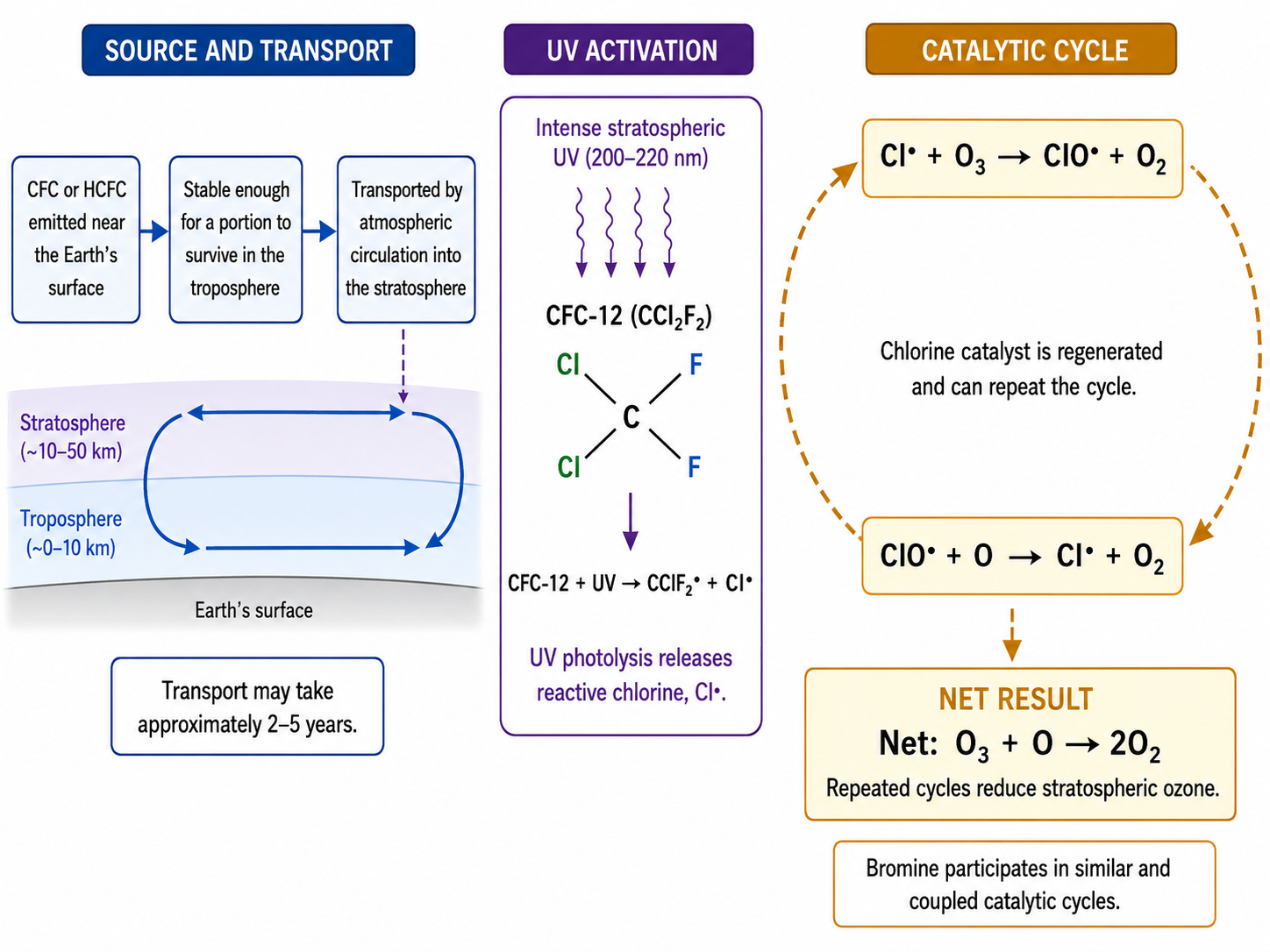
Figure 2.2.1 – Simplified chlorine-catalyzed ozone-destruction cycle.
AI-generated instructional figure: It may contain visual inaccuracies. Use the accompanying lesson text and cited authoritative sources to verify technical and regulatory details.
EPA 608 Exam Focus
What Students Must Remember
- CFCs and many other ODSs are stable enough in the troposphere to reach the stratosphere.
- Atmospheric circulation and mixing transport ODSs; they do not simply float upward because of molecular weight.
- EPA describes transport from the surface to the stratosphere as potentially taking approximately two to five years.
- Strong stratospheric ultraviolet radiation can break ODS molecules apart.
- CFCs and HCFCs can release chlorine.
- Halons and methyl bromide are important bromine sources.
- Chlorine and bromine atoms react with ozone.
- In a catalytic cycle, the reactive halogen is regenerated.
- The regenerated atom can participate in many ozone-destruction reactions.
- In the simplified chlorine cycle, is the catalyst and is an intermediate.
- The simplified net reaction is .
- One chlorine atom can destroy many ozone molecules before removal from the stratosphere.
- HCFCs generally have lower ozone-depletion potential than CFCs, but they do not have zero ozone-depletion potential.
- Bromine is less abundant but more efficient per atom as an ozone-destroying catalyst.
- Polar stratospheric clouds do not supply the original chlorine; they help convert reservoir chlorine into forms that can become highly reactive.
- Severe Antarctic ozone depletion requires cold conditions, particle chemistry, an isolated polar vortex, and returning sunlight in addition to anthropogenic halogens.
Typical Exam Question Patterns
Students may be asked to:
- Explain why CFCs can reach the stratosphere.
- Identify what ultraviolet radiation does to an ODS molecule.
- Identify the source of reactive chlorine or bromine.
- Select the first product formed when chlorine reacts with ozone.
- Identify chlorine monoxide as an intermediate.
- Explain why chlorine is a catalyst.
- Determine the net result of a simplified catalytic cycle.
- Distinguish CFC stability from HCFC reactivity.
- Identify halons as bromine-containing ODSs.
- Explain why one chlorine atom can destroy many ozone molecules.
- Recognize the role of polar stratospheric clouds.
- Distinguish ozone-depleting chemistry from a regulatory phaseout date or service requirement.
High-Priority Reaction Summary
| Exam Clue | Best Association |
|---|---|
| Stable in the troposphere | Long-lived ODS can reach the stratosphere |
| Intense stratospheric UV | Breaks ODS bonds and releases reactive halogens |
| Produces | |
| Regenerates | |
| Regenerated chlorine | Catalytic repetition |
| Net reaction | |
| HCFC contains hydrogen | Greater lower-atmosphere reactivity and generally lower ODP than CFC |
| Halons | Important bromine-containing ODSs |
| Polar stratospheric clouds | Convert reservoir compounds into more readily activated forms |
| Returning polar sunlight | Activates rapid seasonal ozone-destruction chemistry |
Common Mistakes and Confusing Points
Mistake 1: Assuming CFCs Are Destroyed Immediately After Release
Many CFCs are stable in the troposphere and can persist long enough to be transported to the stratosphere.
Mistake 2: Assuming CFCs Reach the Stratosphere Because They Float
Large-scale atmospheric circulation and mixing transport trace gases. Simple density or buoyancy reasoning is not an adequate explanation.
Mistake 3: Treating Ultraviolet Radiation as the Halogen Source
UV radiation does not create the chlorine or bromine element. It breaks ODS molecules and releases reactive halogen species already contained in them.
Mistake 4: Confusing a Chlorine Radical With Chloride Ion
The reactive species in the simplified ozone-depletion cycle is a neutral chlorine radical, not chloride ion dissolved in water.
Mistake 5: Assuming Chlorine Is Used Up After One Reaction
Chlorine is regenerated in the catalytic cycle and can react again.
Mistake 6: Confusing the Catalyst and the Intermediate
In the simplified cycle, is regenerated and acts as the catalyst. is formed and then consumed as an intermediate.
Mistake 7: Assuming HCFC Means Zero Ozone Depletion
HCFCs are generally less damaging to ozone than many CFCs, but they still contain chlorine and have nonzero ozone-depletion potential.
Mistake 8: Ignoring Bromine Because Its Atmospheric Amount Is Smaller
Bromine is much more efficient per atom than chlorine in ozone-destruction chemistry and remains environmentally important.
Mistake 9: Assuming Polar Stratospheric Clouds Cause Ozone Depletion Without ODSs
The clouds help activate chlorine and bromine derived from ODSs. Cold clouds alone do not supply the anthropogenic halogens.
Mistake 10: Treating the Two-Step Cycle as the Only Atmospheric Mechanism
The simplified cycle teaches catalytic regeneration. Actual ozone depletion includes multiple gas-phase, particle-surface, chlorine, bromine, and coupled reaction pathways.
Concept-Check Questions
Question 1
Why can many CFC molecules reach the stratosphere after being released near the Earth’s surface?
A. They are rapidly washed out of the atmosphere by rain.
B. They are generally stable in the troposphere and can be transported by atmospheric circulation.
C. They are attracted directly to the ozone layer by electrical charge.
D. They immediately react with ground-level ozone and become oxygen.
Question 2
What is the main role of intense ultraviolet radiation in the first stage of ODS-related ozone depletion?
A. It creates chlorine atoms from ordinary oxygen.
B. It converts ground-level ozone into CFC refrigerant.
C. It breaks ODS molecules and releases reactive chlorine or bromine.
D. It permanently removes all chlorine from the stratosphere.
Question 3
In the simplified chlorine cycle, what is produced when a chlorine radical reacts with ozone?
A. Chlorine monoxide radical and molecular oxygen
B. Hydrochloric acid and atomic oxygen
C. A new CFC molecule and molecular oxygen
D. Bromine monoxide and carbon dioxide
Question 4
Why is chlorine described as a catalyst in the simplified ozone-destruction cycle?
A. It is converted permanently into ozone.
B. It is regenerated and can participate in repeated reaction cycles.
C. It supplies all oxygen atoms in the stratosphere.
D. It prevents ultraviolet radiation from reaching CFC molecules.
Question 5
What is the net result of the simplified two-step chlorine catalytic cycle?
A. Two ozone molecules are produced from molecular oxygen.
B. Ozone and atomic oxygen are converted into molecular oxygen.
C. Chlorine is permanently consumed to form a stable solid.
D. CFC refrigerant is regenerated from ozone.
Question 6
Which statement correctly compares HCFCs with CFCs?
A. HCFCs contain no chlorine and therefore have zero ODP.
B. HCFCs generally react more readily in the troposphere, so less chlorine reaches the stratosphere, but their ODP is not zero.
C. HCFCs are more stable in the troposphere and always have higher ODP than CFCs.
D. HCFCs cannot be decomposed by ultraviolet radiation.
Question 7
Which substance group is an important source of stratospheric bromine from human activities?
A. Halons
B. Pure nitrogen
C. Molecular oxygen
D. Carbon dioxide
Question 8
What is an important role of polar stratospheric clouds in severe Antarctic ozone depletion?
A. They manufacture CFCs from oxygen.
B. They block all sunlight permanently.
C. Their particle surfaces help convert chlorine reservoir species into forms that can become highly reactive.
D. They remove every chlorine-containing compound from the atmosphere.
Answers and detailed explanations will be provided in
2.11 - Answers and Explanations.md.
Section Summary
Many ozone-depleting substances are released in the troposphere but are stable enough to survive for long periods. Atmospheric circulation transports a portion of these compounds into the stratosphere, where intense ultraviolet radiation can break them apart and release reactive chlorine or bromine.
The simplified chlorine-catalyzed cycle is:
followed by:
The net reaction is:
Chlorine is regenerated, so it can repeat the cycle and destroy many ozone molecules before being removed from the active stratospheric chemistry. Bromine participates in similar and coupled cycles and is highly effective per atom.
HCFCs generally cause less ozone depletion than CFCs because they are more likely to react before reaching the stratosphere. They still contain chlorine and have nonzero ozone-depletion potential.
Polar conditions can greatly accelerate ozone loss by converting reservoir compounds into more readily activated forms. Very cold temperatures, polar stratospheric clouds, isolation within the polar vortex, and returning sunlight combine with anthropogenic chlorine and bromine to produce severe seasonal Antarctic ozone depletion.
The next section compares refrigerant families and introduces ozone-depletion potential and global-warming potential.
References
Current EPA and Government Science Sources
-
U.S. Environmental Protection Agency, Basic Ozone Layer Science, accessed August 6, 2026.
-
U.S. Environmental Protection Agency, Ozone-Depleting Substances, accessed August 6, 2026.
-
U.S. Environmental Protection Agency, Information on Ozone and Ozone Depletion, accessed August 6, 2026.
-
National Oceanic and Atmospheric Administration, Scientific Assessment of Ozone Depletion: 2022 — Twenty Questions and Answers About the Ozone Layer, accessed August 6, 2026.
-
National Oceanic and Atmospheric Administration, Scientific Assessment of Ozone Depletion: 2022 — Executive Summary, accessed August 6, 2026.
-
National Aeronautics and Space Administration, Ozone, accessed August 6, 2026.
-
National Aeronautics and Space Administration, World of Change: Antarctic Ozone Hole, accessed August 6, 2026.
EPA 608 Examination Reference
- U.S. Environmental Protection Agency, Section 608 Test Topics, accessed August 6, 2026.